Transcript
“My mom was a single mom, and my dad left, I think, when I was 2. We dealt with not having a car, like, having to walk, you know, ride the bus all the time, groceries, just, you know, being on food stamps. And my mom was, I guess she was trying to live through her, like, fix her life. She did start dating my stepdad when I was 5. I mean, he was there, but at the time, he was an alcoholic, so he was drinking and stuff a lot.
That was a lot of things that she dealt with, like, always trying to figure out where he was because he was always at a shot house somewhere. Or, you know, we’re driving around at night, we haven’t eaten any dinner, you know, because he works, so he’s the one that buys the groceries, you know. So if he’s not home and there’s not nothing really in the house— I started working when I was 16 just because I didn’t have things that other kids had. And as far as designer clothes or just different things. And I’m like, I need to work so I can buy whatever I want to buy.
Got it. We got evicted when I was a senior in high school and I had to start working. And just going down that road was very stressful. I was always a quiet child. I had very low self-esteem.
Different things, and I just got to a point where I did not talk much, um, and I went into a spiral of thinking nobody cared. Started having like some anxiety bad, um, I didn’t really know why I was living, but there was a lot of unanswered questions that I didn’t have answers to, and I was just angry. At my past life. I was angry at my childhood. I was mad at my parents.
I had a lot of unforgiveness. It came to the point where I was literally just trying to find anything to cover up my pain. So that was alcohol, taking my prescription medication more than it’s telling me to take it because I was just trying to get numb to the feeling I wasn’t being a good mom. Um, it was, it was very dark. Like, I was very in a dark time.
I wasn’t following you guys’ church yet, but I think I was scrolling and I seen an advertisement of KidzFest. I signed the kids up, um, through the app. They were telling me all the things that you guys were doing. They were like, Mom, we just did— we were doing this. We went on top of the building.
I said, y’all went on top of the church? Church building? And they were like, yes! I said, okay. And it was like, it was fun though.
I was like, okay. They were like, Mommy, well, they said on Sunday we’re doing this and da da da. And I’m like, okay. And you know, since that KidzFest, we had just been coming since then. Y’all have been caring the whole time we’ve been here, and kids have learned.
I’ve learned, um, within the time frame that I’ve been here, and that’s where it started, was KidFest. I’ve gotten closer with God, just understanding the Bible more. I always felt like there was some wedge between me and God, like he’s up here, and he’s still up here, but it feels like it’s more understanding, like, you know, you can really understand what he’s saying in the Bible. I’ve learned more that I’ve been here. The years of change that I learned over the time period of my life.
The year I started coming here, that Christmas, I forgave my mom because I wasn’t talking to my mom. I forgave my dad just for different things. And over the time, like, I’ve been here, I have felt more loving from just you guys and just the church, and it’s really helped. Like, it has really helped me a lot just being here. It may look like that you’re going down a dark road and nobody cares, because that’s how I felt.
All I can say is, if you believe that Jesus died on the cross for your sins, truly believe then He can fix whatever you have going on. I knew that the path that I was going down was not— I probably wouldn’t be here to tell the story or to tell anything because I didn’t feel the love, the care, anything. And I would say I’ve come a long way, and I’m grateful.” (End of testimony – Pastor Gary begins the sermon) Yeah, I love hearing stories like that. And what makes it especially timely for us is what she was communicating. Her life was really far from God, and she was in a situation that she was describing where she wasn’t really personally looking for anything.
She was in a dark place, but she was looking for something for her kids. And she sees this Facebook ad about KidzFest, and so she brings her kids and her kids love it. And so they started coming to church here. And so over the past year, they’ve experienced this wonderful life change. Who would have thought that your investment in our “It’s Time” generosity initiative has enabled us to be able to place ads on social media like Facebook. Who would have thought that God could use a Facebook ad to reach a family?
Do you think God does things like that? But it costs resources. It requires resources to do that. And that’s what my wife Robin and I were talking to you about last Sunday. We talked about how this month of November marks 35 years since we started with 7 people in my living room and how God has taken us from that small, humble beginning of really just having a dream from God to do this idea of planting a new church in Wilson that’s now two campuses in Wilson and in Rocky Mount.
That God would do such a thing by using little old me and little old Robin, just the two of us and our little kids, and just saying, ‘God, we’re just going to give you what we have. We’re just going to trust you with what we have.’ And he loves doing that. God loves taking small things. And last week we learned from the book of Zechariah that we’re not to hate the days of small beginnings, of small things, because God loves to take small things, small people, and do great things because we have a great God.
That’s what we’re talking about now in this series. We’re in this series called “It’s Time To Finish.” We’re at the halfway point, the midpoint of our 36-month generosity initiative. We’re saying, we’re repeating these words that we learned from Haggai. Which was the song that you heard earlier, the special song we heard just a moment ago.
And I saw some of the old-timers singing along with it. My son, Stephen, wrote that song years ago based on the book of Haggai. “Be strong, do the work, be fearless.” That’s the season we’re in right now, and we’re at the midpoint. We want to finish well. And so can I remind you of what we talked about last week, of the four next steps for each of us?
The first is to pick it up, to go out in the lobby, even if it’s your first time and get on the spiritual journey together with us. Go out to the lobby, pick up a journey guide, get an ink pen, a bookmark, and start doing the daily devotion that we have in there. And we’re inviting everybody to do this daily devotion together, and we’re praying this prayer. We’re asking, “God, what do you want to do in me and through me?” So, pick it up and then put it up.
Put up the commitment card that you see in your bulletin. We also have them at the “It’s Time” table. And so pick up the commitment card and take it home, and then put it up somewhere. Put it on your dining room table, put it on your refrigerator, and don’t turn it in today because we want you to make a spiritual decision, a faith decision. Bring it before the Lord.
What does the Lord want you to do? How does he want you to use the resources that God has entrusted to you? And so we want you to put it up and then pray it through. “God, what do you want to do in me and through me? And then next Sunday, November the 15th, we’re going to turn in our commitment cards, so bring them back ready to go.
Then, on the following Sunday, November the 22nd, we’re going to celebrate whatever that number is. We’ll report back to you what everybody came up with, what God told you to do, and then we’ll report it to the church. And whatever that number is, we’ll say that’s what God’s doing in us and that’s what we’re going to use for his glory. And so thinking about Shakira’s testimony again, do we want to be the kind of church that just hopes people show up? Do we want to be the kind of church that just hopes somebody’s talking about the gospel, the good news of Jesus?
Or do we want to be the kind of church that is willing to generously give over and above our normal offerings in order to reach more people with the gospel? What kind of church do we want to be? And how many families are out there that are far from God that God wants to bring near and we can do our part? And maybe you’re thinking this morning, well, I want to be part of something significant, I want to be part of something like that, but I’m not that talented. How could God use me? How could he use me?
I don’t have that many resources. I could share a little, but how could God use that? And so what we tend to think is, I can’t speak like him. I can’t play the guitar like him. I can’t sing. I can’t teach children.
I’m not good. You start thinking of what you don’t have. That’s what we often do instead of thinking that’s not what God is looking for. Remember what He told Moses whenever he saw the burning bush and he was telling him, ‘I want you to go back and let and tell Pharaoh to let my people go.’Moses said, ‘I don’t know how to talk. I don’t have a good speaking voice.’
What does God ask Moses? He said, “What’s that in your hand?” And he’s still asking that.
What’s God already put in your hand? What’s the provision God’s already given you? Maybe it’s your time, to give of your time. Maybe it’s your abilities. Maybe it’s to invite somebody to church.
But God is really calling us to partner with him for reaching not only Eastern North Carolina but the world with the gospel, and every one of us matters to God. We entitled our message last week, “Be Strong,” from Zechariah chapter 4, and it was not to be strong in our own strength, but remember what we read? “Not by power nor by might, but by my Spirit,” says the Lord. So we’re to be strong in the Holy Spirit’s power.
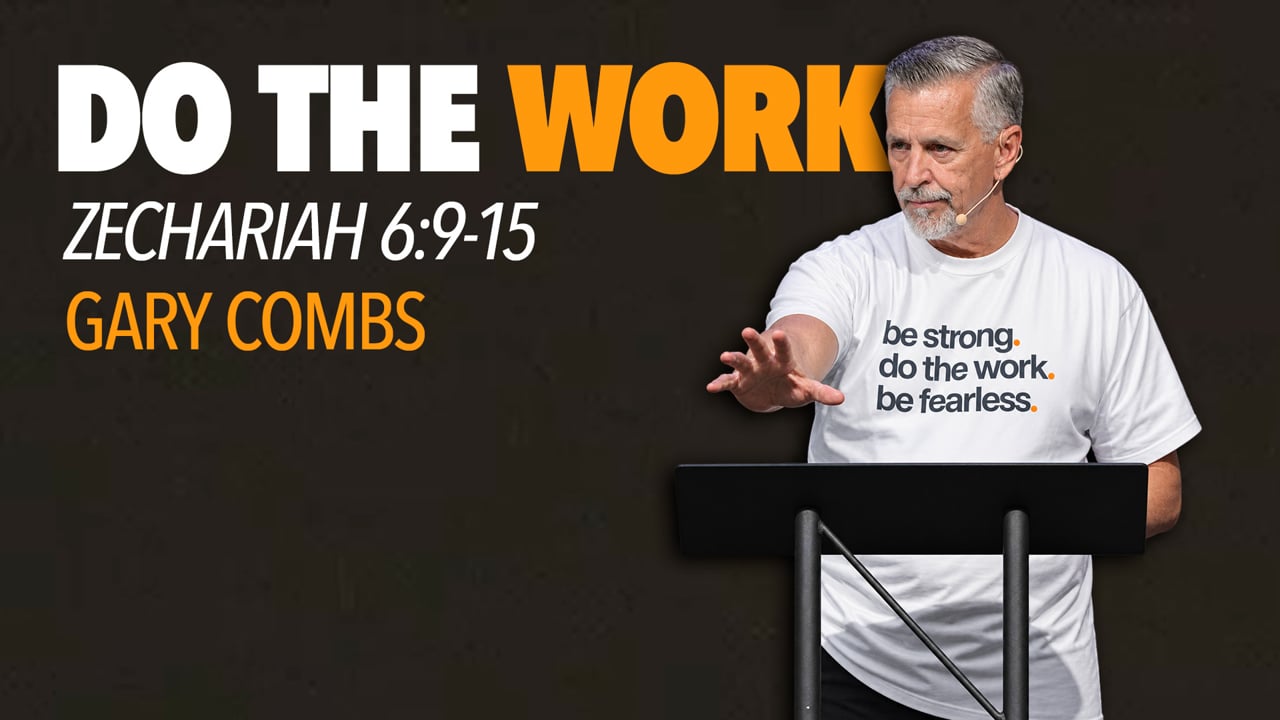
Now, this week we’ve entitled the message from chapter 6 of Zechariah, “Do the Work.” “Do the Work,” not to earn, but to have the Spirit working in us and we’re working out what He’s working in, so that we’re to be part of the work He wants to do because He calls His people to participate in His work. Now, in Zechariah chapter 6, we’re going to be looking at verses 9 through 15. And we’ll see here that the Lord instructed the prophet Zechariah to put a crown on the head of Joshua, the high priest, which was a strange thing to do, but he did it as a prophetic sign of the coming Messiah and how the coming Messiah would build His church and He would invite others to participate in this with Him.
And I believe today we can faithfully participate in the work that Christ is doing to build His church. And as we look at the text today, I think we’ll see three ways that we can be faithful participants in Christ’s work of building the church. So let’s dig in, chapter 6, verse 9.
Zechariah 6:9-15 (ESV) 9 And the word of the LORD came to me: 10 “Take from the exiles Heldai, Tobijah, and Jedaiah, who have arrived from Babylon, and go the same day to the house of Josiah, the son of Zephaniah. 11 Take from them silver and gold, and make a crown, and set it on the head of Joshua, the son of Jehozadak, the high priest. 12 And say to him, ‘Thus says the LORD of hosts, “Behold, the man whose name is the Branch: for he shall branch out from his place, and he shall build the temple of the LORD. 13 It is he who shall build the temple of the Lord and shall bear royal honor, and shall sit and rule on his throne. And there shall be a priest on his throne, and the counsel of peace shall be between them both.”’ 14 And the crown shall be in the temple of the LORD as a reminder to Helem, Tobijah, Jedaiah, and Hen the son of Zephaniah. 15 “And those who are far off shall come and help to build the temple of the LORD. And you shall know that the LORD of hosts has sent me to you. And this shall come to pass, if you will diligently obey the voice of the LORD your God.”
This is God’s word.
Amen. We’re looking for three ways we can participate in Christ’s work of building the church.
Amen. We’re looking for 3 ways we can participate in Christ’s work of building the church.
1. Generously Giving from What God Entrusted
Here’s the first way. It’s by generously giving from what God has entrusted to us. By generously giving from what God has entrusted to us.
He begins with, “And the word of the LORD came to me.” This is Zechariah writing. The word of the LORD came to him. He had just seen a vision. It was the eighth of eight night visions that he saw in one night.
He’d just seen a vision of four chariots, but then he hears a word from the Lord here that he’s going to now give to us. He gave it to that century of people; those exiles who had just returned. And he says, basically, ‘Thus says the Lord,’ which is a desire of my heart every Sunday, And so I get up early before the sun comes up and I pray, ‘Lord, may I be able to preach today so that it’s Your word, not mine, so I can get out of the way.’ I pray that it will be your word. The authority of my preaching does not come from the way I speak, but from the word I speak, and that it is the word of the Lord.
And this is a prophetic phrase that we see throughout the prophets that they’re saying, ‘this is not my opinion, this is a word from the Lord.’ This is a word from, and you’ll see it is in all caps, the L-O-R-D. It’s a word from Yahweh, which is the covenantal name of God. And so he says, verse 10, “Take from the exiles” is the word of the Lord. And so Heldai, Tobijah, and Jedaiah have just returned, it appears, from Babylonian exile. They didn’t come apparently with the first wave that came with Ezra, who wrote the book of Ezra, Joshua the high priest, and Zerubbabel the governor who was in the line of David.
He would have been king, but he’s the governor under Persian rule now. And so they returned under King Cyrus of Persia who had overthrown the Babylonians. They had returned, but now here come these threedudes, And they’re coming now. So they’re a little bit delayed getting there, and they’ve apparently brought offerings of silver and gold, probably thinking that they are going to bring it to the temple, but the temple hasn’t been rebuilt. They’ve laid the foundation and the work has gone unattended for sixteen years.
And so the people are discouraged, but these guys show up with silver and gold, and they get a word through the prophet Zechariah that they’re to go over to the house of Josiah, the son of Zephaniah. Now we don’t know who Josiah is. All they know is they know his daddy’s name is Zephaniah and he has a house. That’s what we know about Josiah. Now he could have been the one because we see that they were to bring that silver and gold, which they probably were bringing as an offering to the temple.
That’s probably what they were doing. But now they’re going to be asked to do something very unusual. And this is one of the things about reading the prophets is that sometimes God not only gives them a word, but he also gives them an illustration that they have to enact. And so the illustration here, he says, ‘I don’t want you to just talk about it, I want you to actually take the silver and gold from these three guys.’ and notice it says “take” twice. Take it from them, they’ve brought it as an offering, take it from them, but this time, instead of just putting it in the temple treasury, make a crown, and then take that crown and put it on the high priest’s head, Joshua, the son of Jehozadak. Put it on his head; he’s the high priest. Now look, here’s the thing that we learned back in chapter 3 of Zechariah is that God’s already given him a new wardrobe.
He said that Joshua was impure and he needed to be purified before he could be the high priest, and he needed to be purified and then put on new clothes and put on a new turban, which is what the high priest would wear. He’d wear a turban on his head that had a gold plate on the front that said, “Holy Priest Unto Yahweh,” holy unto the Lord. And so he’s already got a hat, and here’s this word from the Lord that Zechariah is saying, ‘hey, I need you guys to go over to Josiah’s house. Maybe Josiah makes crowns. I don’t know why they had to go over to his house.
Maybe they were going to spend the night at Josiah’s house. Maybe he’s showing them hospitality. We don’t know. When I get into these stories, I try to visualize what was happening. Maybe he’s the goldsmith or maybe he’s the crown maker, but they go over there and they make a crown and they call in the high priest and they put it on his head, but not long.
They just put it on his head and then Zechariah says the words God told him to say and then they take it off his head and they put it in a place in the temple. It becomes a memorial in the temple. Why do all this? In order to put substance so they could really get it to what’s coming, there’s a Messiah who will unite all the offices of prophet, priest, and king under one crown that’s coming.
And so here’s the part I want us to focus on now. I just want us just to look at verses 9 through 11 now. I’ve given you what’s going on, the big picture. Let’s bring it in; here’s what’s going on.
He says their names. I want you to take note of that first of all.
Heldai, Tobijah, and Jedaiah. Who are these guys? We don’t know. They just came from the exile. That’s all we know about them.
The other thing we know is they have some silver and gold. That’s all we know. Wait a minute, there’s one other thing we know. When God’s word comes their way, they obey it. Oh, so we know they’re obedient.
Here’s what else we know. We know they’re generous. We know, and here’s one more thing we know. God knew their names and he had it put in His book.
Ordinary men bringing their offerings, and God took note of their names and had it put in the book. Were they warriors? Were they heroes? No, they were guys that brought their offerings and God put their names down in His book. That’s what we can take note of.
That’s what I wanted you to really grasp right here, that they’re generously giving. Maybe not what they meant to give. They brought it probably thinking, I’m just gonna put it in the temple offering, but no, it’s going to be used for this symbolic prophetic crown that will be a memorial in the temple. And so they make it so. You see, God cares more about our attitude of obedience than He does the amount of our offering.
He cares more about our attitude than the amount. And after all, it’s His grace that enables our generosity. How could we be generous unless God first abounds to us, is generous to us? And this is what Paul’s writing about in 2 Corinthians chapter 9. He says,
2 Corinthians 9:7-8 (ESV) Each one must give as he has decided in his heart, not reluctantly or under compulsion, for God loves a cheerful giver. 8 And God is able to make all grace abound to you, so that having all sufficiency in all things at all times, you may abound in every good work.
And so Paul’s teaching the church at Corinth, which was a wealthy city, a wealthy church, He’s teaching them, as God has abounded to you, abound to God. He’s the one that enables their giving, but he really focuses in on their attitude. Don’t do it out of compulsion. Don’t do it because Preacher Paul told you to do it, or Preacher Gary told you to do it.
Don’t do it because of that. Don’t do it because of an emotional appeal. Don’t do it because all of us wore t-shirts that looked alike.
Those are just to get your attention. So you’ll actually think about this. Do it because God’s generous to you and let that generosity that flows to you and through you flow to his work. And so you become a channel, a conduit, a river of God’s generosity. He can trust you, he can abound to you because he knows you won’t dam it up downstream.
You’ll receive from him and you won’t keep it to yourself, you’ll let it flow to you and through you. Notice he cares about the attitude, that it’s cheerful. And “hilarós” is the Greek word here. It’s the source word or the origin word for an English word that we have. It’s called hilarious.
In other words, we should give until it cracks us up. We should do hilarious giving. The attitude is hilarity, that this is fun. Look what God does, and it was never mine anyway, and I can be generous because I’ll never run out as long as I’ve got my hand open to God and open to others.
There’s a story in the book of Mark, the Gospel of Mark chapter 12, that talks about Jesus watching the people give. That seems, well, it just seems inappropriate almost. Like, what was Jesus thinking there? I mean, these people are trying to give and he’s sitting across from the place where they’re dropping their offerings into the treasury boxes at the entrance to the temple. And they had built these boxes, and maybe you’ve seen these at a museum or some nonprofit where they have like this trumpet-shaped opening where you can drop coins in the big side of it and it goes down into the box.
And so they had something like that. And so here comes a rich man and he pours it in there. I bet every head in the temple turned; it went, “cling, cling, cling, cling, cling, cling, cling, cling, cling…” Everybody saw it. But then here comes a little widow lady.
And how does He know that she’s a widow? Because he’s God, it’s Jesus. He knows who she is; He knows her name, He knows how much she gave. The scripture says she gave two mites, or two copper coins. Dink, dink, it didn’t even make a sound, and she didn’t want it to make a sound because she’s little.
And she doesn’t have much. He turns to His disciples. He says, ‘do you see that rich man? He gave out of his abundance, but that widow, she gave out of her lack, for she gave all that she had.’
Who gave the most? He said that she did because of the attitude of her heart and that she trusted Him with all that she had, not just the leftovers. Here’s the part I want you to capture though, that I want to hear from Mark chapter 12 – Jesus was watching their giving.
Do you think He’s watching yours? Do you think He cares about your giving? This doesn’t make as much sense as it used to when I first started preaching, that he’s watching your datebook and your checkbook. We don’t have those anymore. I think we have them all on our phone or our watch or something like that. But do you think Jesus cares about how you spend your time, how you spend your talent, how you spend your treasure?
Is he watching? He is. And he put the names of these three dudes in his book because they made a contribution. We put something else in your bulletin this morning. If you picked up a bulletin, it’s called “The Generosity Ladder.”
We’ll pop it up on the screen as a reminder here. And it shows how you might grow in your spiritual discipline of generosity. It’s really, I think, a mark of Christian maturity. Some would think, well, being a Christian, being a mature Christian means you’ve memorized several verses of the Bible. Well, that’d be good.
It means that you have shared your faith. Well, that’s awesome. Yeah, it means that. It means that you go to church regularly. Absolutely.
But you know, another mark is generosity. And for some of us, I would say maybe you’ve never given. Every Sunday there’s someone who, who decides, you know what, I’m going to start, I’m going to be an initial giver. And that’s your step today on the spiritual journey of generosity. Why not just make an initial gift and say, ‘God, it’s not much, but it’s what I have, and I trust you to multiply it and to use it in your kingdom,
to make an offering and make it as a spiritual matter from the heart with a cheerful heart.’ Some of you are givers, but you’re inconsistent. You give whenever you think about it, and you sometimes don’t think about it and you forget, but you mean to. Why not take a step towards consistent giving and say, ‘I’m going to look at how much I have, and I’m going to decide to be a tither. I’m going to give 10% of what I have.’
Others will be sacrificial givers; those are really the ones we’re aiming at for the “It’s Time generosity initiative. God’s calling you to give over and above giving so that you can help us reach more people with the gospel. And then some of you may be in my age group, and you’re starting to visualize what it would look like to be a legacy giver and to make sure a portion of whatever God allows me to leave behind goes into his kingdom work. I’m just calling you to think about your generosity. And I know it makes you nervous. I know it makes you nervous because we’re all Americans and we struggle with the way that greed gets an entanglement in our heart and becomes like an idol.
We hate it when the preacher talks about money. But Jesus talked more about money in the Gospels than he did heaven or hell. Go look it up. He talks about it because it becomes a false idol to us. How do you break the idolatry of greed?
Through generosity. It’s like the medicine that you need by being a giver with your time, your talent and your treasure. Let’s give generously. That’s what I see here in verses 9 through 11, that these three men were honored for being givers. Let’s keep going.
2. Confidently Trusting in What God Promised
Here’s our second way that we can participate faithfully in the work of Christ building his church. It’s by confidently trusting in what God has promised. By confidently trusting in what God has promised. We’re at verse 12, “And say to him, ‘Thus says the LORD of hosts, “Behold, the man whose name is the Branch: for he shall branch out from his place, and he shall build the temple of the LORD.” “And say to him— so you’re going to say to Joshua as you put this crown on his head – here’s what you’re going to say: .
<p class="transcript-paragraph" data-start-time="1721762" data-end-time="1746949" ‘Thus says the LORD of hosts, “Behold, the man whose name is the Branch: for he shall branch out from his place, and he shall build the temple of the LORD.” Now, a couple of comments right here. First of all, does that “Behold, the man” give you any recognition about another place that's significant in the Bible? It does me, because centuries later, there's a crown put on another man's head.
And it’s not a crown made of silver and gold, it’s a crown of thorns. And a Roman governor named Pontius Pilate brings Him out with a purple robe on His bloody shoulders and His bloody back that had been beaten and His beard plucked out so that blood’s running down His face. And a crown is sure enough on His head, but it’s a crown of thorns. And he brings Him out and he says, “Behold the man.”
There’s something here, isn’t there? There’s something. You see, God stands outside of time. He’s not limited by time. He’s the creator of time.
“In the beginning” is a time word. “In the beginning, God created the heavens…” He stands outside of space, time, and matter. He created them all. And so He sees everything at a glance from beginning to end.
He’s God. He’s all-knowing. And here come the words out of Zechariah’s mouth as he puts the crown on Joshua the high priest. He says, “Behold the man,” and then he says, “whose name is the Branch.”
That’s not Joshua’s name. But, that’s not what God told me to say though. Here’s what God told him to say, “Behold the man whose name is the Branch.” Okay, who’s that?
That’s the thing about these prophetic words. You have to read larger segments of the Bible to get the keys out from under the door so you can understand what they’re talking about. This “Branch” is something that Joshua would’ve recognized. So would those other three dudes that came back from Babylonian exile. So would Zechariah who’s writing this. Why? Because two prophets before the exile, Isaiah and Jeremiah, had both written about it. We’ll pop up this image for you here for those of you that like to take notes.
I don’t have time to read all these, I wish I did, But Isaiah talks about this sprout that will sprout forth from Jesse and become a branch, and it’s a Messianic. It talks about His righteous kingdom that’s coming. He talks about it twice in Isaiah. And then Jeremiah, who prophesies after Isaiah, both of these before the Babylonian exile, he talks about it twice. So here’s Zechariah, and he talks about it twice, once from chapter 3, Again, here from chapter 6, he’s using a phrase now that’s in the minds of the exiles.
They’ve had the book of Isaiah, they’ve had the book of Jeremiah, they’re students of God’s Word. They know when he talks about the Branch, he’s not talking about Joshua, he’s talking about Messiah, the Christ who is to come. He puts this crown on His head and he says, “Behold the
man whose name is the Branch: for he shall branch out from his place,” He’s going to become visible. He’s going to become not just a branch, not just a sprout, not just a branch, but an olive tree, which is the church. And He shall build the temple of the Lord. What?
This Branch is gonna build the temple? But he’s not talking about that temple that Zerubbabel and Joshua and Zechariah are trying to build. He’s talking about us; he’s talking about the church. To be clear about who’s building it, it’s not that he stutters here, he becomes emphatic. In case you didn’t hear what I said, he says it like this,
Verse 11, “…and he shall build the temple of the LORD. 13 It is he who shall build the temple of the Lord.”
Let’s be clear about this. It is Christ who will build His church. He will build His church. 13 “It is he who shall build the temple of the Lord and shall bear royal honor, and shall sit and rule on his throne.”
He shall be King. “and shall sit and rule on his throne. And there shall be a priest on his throne, and the counsel of peace shall be between them both.” Now, upon first reading, when I read “shall be upon them both,”at first I thought he was talking about Zerubbabel, the governor, who would have been king, but now he’s the governor under Persian rule. He was in the line of David, he would have been king, but he’s not.
I thought maybe it meant Zerubbabel and Joshua, and on first reading, that’s what I thought it meant, but the more I looked at it, the more I realized, no, he’s talking about the Branch, and that within the Branch, which is the Messiah, there would be peace, counsel of peace between these two roles, that now the priest and the king are one. And so that King Jesus, the risen King Jesus, is now seated at the right hand of the Father as our holy great high priest. And it’s already coming to pass, but it isn’t here yet. It hasn’t happened yet, but they’re being given a glimpse of it here. And so just for a moment, he puts the crown on Joshua’s head and he says, “Behold the man who is the Branch.”
And he speaks this word of prophecy. Now the crown is to be placed in the temple as a memorial gift.
He renames those guys, the three guys, he names them again. Now, what are we called to here as we answer God’s call and we partner with Him as Christ builds His church? Are we called to build the church?
No, we’re called to BE the church, and Christ is the one who will build the church. And so this causes me to hearken back to the 1990s when we first started and we finally had enough money to rent an office space for the church. It was no longer an upstairs bedroom at my house; it was for a little while. I had all of my family, including my little kids, answering the phone. Back in those days, we were called Wilson Community Church.
They would answer the phone, “Hello, Wilson Community Church,” at my house, because my house phone was the church phone. And in those days, there was no internet, so everybody just called me, you know, and that’s how it used to work. But we got an office building, and I started teaching through the book of Ephesians on Wednesday nights. We had a little conference room that we would meet in. I started seeing this idea that it was Christ that was building the church. So what are we supposed to do?
What’s our partnership? We’re supposed to BE the church fully. Fully embodying what he’s called us to be. And so I remember I had this dot matrix printer; you old people tell the young people what I’m talking about. It came with continuous paper that had perforations in it, and you could make posters on these things by using X’s and O’s. And I made a big poster that I put in the Boles office building in the conference room that said, “If we will BE the church, capital B, capital E, and then we can trust Christ to build the church.”
He said that to Peter, didn’t he, in Matthew chapter 16? “Who do people say I am and who do you say I am?” And Peter says, “You are the Christ, the Son of the living God.” Jesus makes this confession. He says, “Upon that confession, upon that rock,” Matthew 16:18 (ESV) “… I will build my church, and the gates of hell shall not prevail against it.”
So Jesus has always said from the very beginning that He’s going to build the church. What’s our part? To be the church. To be the church and to trust in him. And you might say, ‘Well, Gary, that’s awesome.
I want our church to grow, but my house is a mess.’ Let’s look at that for a second. What if you said, ‘I want to be the man of God that God’s called me to be?’ Stop complaining about your wife and your kids. ‘I want to be the man that God’s called me to be.
If I’ll be the man that God’s called me to be, I can trust Christ to build my house.’
‘If I can be the woman of God that God’s called me to be, if I can be the woman of God and trust God with my husband and my kids…’ “Unless the Lord builds the house, the laborers labor in vain,” the psalmist says. It’s the Lord who builds your house and his house. We can confidently trust that he will do what he promised.
It says in Ephesians,
<p class="transcript-paragraph transcript-scripture" data-start-time="2246132" data-end-time="2267373" data-spoken=Ephesians 2:19-22 (ESV) 19 “So then you are no longer strangers and aliens, but you are fellow citizens with the saints and members of the household of God, 20 built on the foundation of the apostles and prophets, Christ Jesus himself being the cornerstone, 21 in whom the whole structure, being joined together, grows into a holy temple in the Lord. 22 In him you also are being built together into a dwelling place for God by the Spirit.”
What’s this? It’s a picture of the temple that Christ is building. Even now He’s building it, and some of you here this morning may make a decision later today at the conclusion of this sermon to decide to follow Jesus as your Lord and Savior, and then you’ll be a new member of the temple He’s building.
That’s what God— that’s what Christ is doing. He’s building His church right now. He’s building it all over the world. And we may make our plans, organize our ministries, build facilities, but only Christ can change a heart. We can buy Facebook ads, we can wear cool white t-shirts, we can do all kinds of things, and we should, but only Christ can change a heart.
And so our part is the easy part, and that’s to trust God with our stuff, our time, our talent, and our treasure, and ask him to show us the increase by building from what we’ve given to him that actually he originally gave to us. And so that’s the second way.
3. Faithfully Helping Where God Directed
Here’s the third way that we can be faithful participants, and it’s by faithfully helping where God has directed. We’re at verses 14 and 15.
By faithfully helping where God has directed. And in verse 14, it says, “And the crown shall be in the temple of the LORD as a reminder to Helem, Tobijah, Jedaiah, and Hen the son of Zephaniah.” Speaking of the crown they’ve made, the one that was briefly on Joshua’s head, he didn’t get to keep it long because it was always a memorial to the One who’s to come, that’s the Branch, “And the crown shall be in the temple of the LORD.” I wonder if it was still there when Jesus came. When Jesus walked into the temple, I wonder if it still was on a shelf somewhere in the temple. I wonder, I don’t know.
We don’t see any further mention of it. I know there’s some non-biblical writings in the Mishnah and some of the Jewish writings that mention something about these memorials that were in the temple, so I don’t know. But the temple that Zechariah rebuilds, it’s often referred to as Zechariah’s Temple or the Second Temple, it’s the temple that Jesus walks into. Now, Herod the Great did supersize it somewhat and built the Western Wall and added to the size of it, but it’s the same temple that Jesus, the Branch, branches out into centuries later. And so I wonder if that crown was still there. And it says it’ll be a memorial. It says it’ll be a reminder, literally a memorial to Helem, which is probably the same name as Heldai.
Maybe it was his nickname. Both of those names tend to mean strength. Tobijah, Jedidiah, and then Hen is probably Josiah. “Hen” means favor or grace, but it seems to be the same three men plus Josiah’s house that they’re talking about, that somehow this crown will be a reminder, not only that they gave their silver and gold, but that the crown points to the Branch who will be the one who ultimately wears it. And so that’s important that they know this and that they have this prophetic sign as a reminder and that they were involved in it and God took note of their names.
But then He says this amazing thing in verse 15. He says, 15 “And those who are far off shall come and help to build the temple of the LORD. And you shall know that the LORD of hosts has sent me to you. And this shall come to pass, if you will diligently obey the voice of the LORD your God.” Now, who are “those who are far off?” Well, maybe in that time period it was referring to other Jews that were like the three dudes. They got there a little bit in a later wave or later. Maybe they were coming back from other parts of Persia or Egypt, perhaps.
But we know that whenever the Apostle Paul starts interpreting this, and I think that gives us a good interpretation from the Holy Spirit of what this really means, we see it in Ephesians, and I’m glad that we just spent several weeks in Ephesians a few weeks ago. It says in Ephesians chapter 2,
Ephesians 2:19-22 (ESV) So then you are no longer strangers and aliens, but you are fellow citizens with the saints and members of the household of God, 20 built on the foundation of the apostles and prophets, Christ Jesus himself being the cornerstone, 21 in whom the whole structure, being joined together, grows into a holy temple in the Lord. 22 In him you also are being built together into a dwelling place for God by the Spirit.
And so he seems to be here clearly referring to the Gentiles. And so we see a prophetic sign here in verse 15 that there will be Gentiles who will come and help. They will come from far away through Christ, and they will help in the building of this new temple, this church. Verse 15 “And those who are far off shall come and help to build the temple of the LORD.
That’s a calling, isn’t it? That’s a calling that we’re called to, to come and be partners with what God is doing, to bring what little we have, what little time, talent and treasure that we have and become participants in what God is doing in his kingdom. Because make no mistake about it, regardless of what we’ve learned about politics in the past week, about who’s going to be sitting in what seat in Washington, D.C., or in the governor’s office; regardless of all of that— and all those things are certainly important. Here’s the one thing we can know for sure of who sits on the throne now and who’s returning and bringing it all to pass, and that we can help that kingdom come because above all things, we are dual citizens. Yeah, we’re citizens of the US, and that’s something to be proud of, but we are citizens of heaven because of Jesus. That investment we make in the kingdom of heaven is an eternal investment and it matters and we can help in this.
And so we read in Ephesians chapter 4,
Ephesians 4:15-16 (NIV) Instead, speaking the truth in love, we will grow to become in every respect the mature body of him who is the head, that is, Christ. 16 From him the whole body, joined and held together by every supporting ligament, grows and builds itself up in love, as each part does its work.
So we’re all called to do that work, as members of the body that’s appropriate to the gifting and abundance that God has given us. Now, what part has God called you to play at Eastgate,at this church, at this time? Where’s God called you to be involved?
Maybe it’s just to invite someone to hear the gospel. Maybe it’s to invest in over and above giving. Maybe it’s to serve on one of our many service teams. Whatever it is. Maybe it’s all of those things because you really feel called. I just want to take a moment right now to get a little bit more specific about the commitment card because next Sunday’s the Sunday we’re turning them in.
You’re still thinking about it. Some of you are existing commitment people, and that’s because you started with us back in January, February, March of 2025 when we first kicked off the 36-month generosity initiative. And you’ve already made a commitment, a faith commitment, and you’re faithfully giving to it right now. You should have gotten a letter a couple weeks ago that reminded you of your faith commitment, what the number was, and preparing you for this. And so your calling will be, if you still feel that God’s called you to do what God called you to do, to write it down because it’s a faith commitment.
It’s not a contract between us and you. It’s something between you and God. And just write down the number that you’ve already committed to and check the box “affirm.” And then put the total at the bottom, which is the same total you put in 2025. And what you’re telling us is like, ‘Yes, I’m going to keep the commitment I told you.’
See, that helps us plan on the way we manage the funds as they come in. Some of you had a promotion or you had some windfall come your way and you might add an increase. I’m talking to the people that have been on the journey the whole time, and you’ll put that and you’ll add it to your total. Now many of you have only started coming recently, and so the orange box is for you, “new commitment.” And I want you to just pray, ‘how can I be part of the back half of this, the last 18 months?
What would be my level of giving that God’s calling me to give over and above my normal giving?’ And you’ll write that down and put the total amount of how much it’ll be after 18 months. I want you to make a mindful, a spiritual, a faithful decision, not under compulsion, not under emotion of me trying to move you in some or manipulate you.
I want you to talk to God about it and say, ‘God, what do you want to do in me and through me to show me your abundance and your grace as I faithfully steward that which you’ve given me towards your kingdom?’ And then turn it in next week, and whatever that amount is, we’re going to add it all together, and on the 22nd of November, we’re going to celebrate whatever that number is. Okay, that’s the plan. So that’s what I’m having you take home and pray about it one more week before you turn it in next week.
Okay, as we close today, let’s think again about those three men. Those three men, just ordinary men coming back to bring their offering, but apparently it was important enough to God to take note of their names. And to put them in his book. He’s watching, and he took note of it. Why?
It’s because they participated. And isn’t that what we’re seeing here at Eastgate right now? Someone gave, someone served, someone invited, and then people came to Christ. People heard the gospel. Their lives were changed.
Their families were changed. It’s because someone decided to faithfully participate in God’s kingdom. And that’s what we’re inviting you to be part of. And I would remind us one more time that it is Jesus who builds the church, and it’s Jesus who builds your house as you trust in Him. And He’s the one whose crown was not the crown of silver and gold, but it was the crown of thorns that was put upon His head.
Behold the man, who died for our sins, was crucified and buried and raised again on the third day. Behold the Man who is the Branch who has come. He’s building His church, and when He’s finished, He’s coming again to take us to be with Him for eternity. Are you part of that church? Well, there’s only one way, and it’s to know the Man, the Man Jesus, to receive the Man, the Lord, the Son of God, Jesus, who died for our sins.
I want to pray for you right now. And Lord, we call ourselves now, we say to ourselves, we want to join you in this work. Dear Father, thank you for Jesus.
Thank you that he’s the one who is building this church. He’s the one that is calling people by name right now to come to him. It’s by his Spirit. And if that’s you that he’s calling, your part is to say yes. Your part is to repent of your sins and say, I’m sorry, I want you in my life, Lord Jesus.
I believe you died on the cross, that you were raised from the grave, that you live today. By your Spirit, come and live in me. I surrender my life to you. Forgive me of my sins and adopt me into your family as a child of God. I want to follow you.
If you’re praying that prayer of faith, believing he’ll save you, he’ll make you his own— he’s calling people right now. He’s building his church. And others are here today, and, and you’re just now realizing, hey, I want to be part of this. God, show me what you want to do in me. God, show me what you want to do through me.
All I am and all I have is yours. In Jesus’ name, amen.