Transcript
Good morning, church. It is good to see all of you here today. We’re kicking off a new series called, “It’s Time to Finish.” Over the next four weeks, we’re going to be working through that. And I thought, what a great opportunity to invite my most favorite person in the whole world to be up here with me to kick this off!
And that’s my wife, Robin. If you’ve been wondering who the lady is behind the keyboard, it’s my wife. And she’s been not only behind the keyboard, but behind me all these years together as we planted this church together some 35 years ago. We’re kicking this series off because it’s the halfway mark between when we first started our “It’s Time” generosity initiative. It’s a 3-year giving initiative to “be strong, do the work, and be fearless.”
And we got that word from the book of Haggai. And so for these 4 weeks, we’re going to be checking back in to encourage ourselves to continue to what we started to the finish, to finish well. And we’re going to be looking at a contemporary of the prophet Haggai, and that’s the prophet Zechariah. They were both prophesying in the same time period to rebuild the temple. Now, Haggai encouraged the people of God to get started on the work, and Zechariah encouraged the people of God to finish what they had started.
And so we want to do that too. We want to finish well. Now, I said that it’s been 35 years. This is November 1st, Robin, and I’ve been thinking, 35 years ago, November 1991, we started this church in our living room and we invited people and we had 7 people at that first meeting. Do you remember that?
I remember it very well, and you and I were part of that 7. Well, I always try to count in a positive way. So it was 5 people that showed up, counting us, it was 7. There we are in our living room.
And so that’s how we started. We started really small, but God’s been faithful and we’ve grown from 7 people in our living room to 2 campuses meeting every week in Wilson and Rocky Mount. God is the one who did it. Now, do you remember those early days of the kids around the dining room table right after we would finish dinner on Saturday night? Every week I would have the bulletins printed out and I would have the kids folding the bulletins for Sunday morning.
Stephen would be the professional folder. He was 9 years old, so he was the best at folding. Jonathan, our second child, was 6. He would stick the insert in. And then Erin was 5 and she’d put the connection card in, which the connection card was not the connection card back in 1991.
It was the blue card. How many remember that? Yeah, there you go. Okay, there’s two people back there that remember that. Don’t forget your blue card.
Some of you could have raised your hand, you just didn’t want to date yourself. And so we used to say, you know, ‘fill out the blue card,’ but it was the connection card. Yeah, and that’s what it was like back in the day. And can you remember those early Sunday mornings? We were portable for 19 years.
Those early Sunday mornings when Stephen and I, because he was the oldest, would head out to set up the sound equipment and all that. And then you would come with Erin and Jonathan. Jonathan is the pastor of our Rocky Mount campus now. We would come and unload all the nursery equipment and we would take it to the cafeteria at Forest Hills Middle School and we would set it up. That was our job.
Erin took it very, very seriously, but Jonathan, not so much. He just loved to run. But thank goodness he’s pastoring now. So, yes, we remember that very, very well.
Jonathan turned out okay. Yeah, he did turn out okay. But the thing that maybe some people don’t realize is that we would set up and tear down and it didn’t matter if it was sun, sleet, or snow, or rain.
We were setting up. So, we’ve never gone to church in the same car for 35 years, from the beginning until this morning. We have different times that we have to be here, different things that we’re doing, but it’s been a joy. It’s been a joy to do this together, and I wouldn’t have it any other way than starting this church with my wife. I couldn’t have done it without the Lord.
We couldn’t have, but I certainly couldn’t have done it without my wife. Now look, honey, we’ve been at this for 35 years, and I’m getting older. I don’t think you are, but I feel like I’m getting older. I am 6 months older than you, but we’re the same age today. For half the year, I’m with an older woman, but the other half we’re the same age
and he reminds me every year. So, isn’t it time for us to just kick back? I mean, we’re getting older. Shouldn’t we just let the young people handle it from here on in. Why keep sacrificing?
Why keep driving to church in separate cars and doing all this serving and giving? Isn’t it time for us to take it easy? Don’t you think? Well, the Combses have always been told if they start something, they have to finish it, right, Erin? So I want to finish well.
I want to finish well. I have a necklace that says, “But God.” I want to be part of that, “But God” story and be part of that journey to be strong, do the work, and be fearless. So we have to keep working. We have to keep going.
As long as God gives us strength in our bodies, we want to keep going. And so she— so you named our 3 words that we’re reminding ourselves from the book of Haggai – “Be strong;” we said we want to be strong in our community engagement.
And it’s been happening. You’ve been giving faithfully and we’ve been seeing more people come to church than we’ve ever seen. Record numbers of people coming to church. You might say, well, why does that matter, Gary? Because every person who comes represents a soul that needs to hear the gospel.
And every Sunday we’re hearing first-timers coming saying, hey, we saw it on the internet, we watched a sermon clip…
All of that requires resources in order to do that. And you’ve been faithfully giving. Why does it matter? It’s because those people are coming to Jesus.
They’re getting baptized. They’re getting their lives straight. They’re experiencing real life change. And so we want to keep being strong at getting the gospel out. We want to “do the work.”
We want to keep working in the power of the Holy Spirit. We’ve hired two new staff, one for Rocky Mount campus and one for our Wilson campus. We’re still looking to grow our staff. And you’re helping us by your faithfulness and giving. And then finally, we want to “be fearless.”
We want to keep believing. We want to keep dreaming for the future, for what God wants to do through us. Last year we fearlessly took hold of a new property for our Rocky Mount campus, and that campus has more than doubled in size overnight. Amen.. Let’s clap.
We see people coming to Christ in greater numbers in Rocky Mount, and we want to set aside that money that is still after we’ve accomplished these three goals. We want to set that aside for the development of a future worship center for this campus, which is something that we’re still dreaming of. We’re still meeting in an old movie theater that we bought and remodeled. And so we’re dreaming of what God’s doing next. We want to be fearless about that. Now let me give you a quick update about where we are.
At the beginning of 2025, we said we think we need to raise $1.5 million in order to accomplish these three goals. So we brought it to you, the church, and we prayed together about it. And you came back with commitments that equaled over $1.6 million.
We’re a little over 43% right now in actual giving. We’re at the halfway mark. And so maybe we’re a little bit behind where we should be in terms of 50%. But here’s what I know about you. Some of you, when you made your commitment, said, we’re going to be praying to be able to do a lump sum at the end.
Some of you have scheduled it that way. You’ve made that kind of plan. I’m not worried about it because whatever number comes in, that’s God’s number and God’s the one doing it through us, right? Right. The main thing, our primary goal is not a dollar amount, although we do need that resource in order to accomplish these three goals.
Our main goal is that we go on the spiritual journey together and see God move and see God stretch us in our generosity. So we’re not asking everyone to give the same amount. What we’re asking is everyone to bring that before the Father and ask the Lord, what’s my amount? I want to be part of this story and I’m new here, but I want to get on the journey with you.
Now that brings us to some handouts and some pieces that we have out at the It’s Time table. Robin, I know that you love journaling and we’ve got a 21-day journal inside this booklet. I do love to journal because I love to see what God is doing in my life and in the people— in his people’s life as well. And this journal is exciting to me because we can do this together. We can go on this journey together.
And when you go to this time of looking at the 21-day commitment there is what we call S.O.A. P. —Scripture, Observation, Application, and Prayer. It’s a great way to study God’s Word, and we’re going to be studying it together. That is very exciting.
So we’re going to go on a 21-day journey together that starts tomorrow. She’s referring to our method of studying Scripture called S.O.A.P. There’s space in this journey guide for you to do a daily S.O.A.P. devotion. And look, Robin, because I know you love this stuff— we have a special pen and a special bookmark; all of these things in order to be able to do this journey together.
All you have to do is stop off at the table and pick it up. Now, one of the things that would really encourage us is if you’re on Instagram or if you’re on Facebook or something like that, when you’re doing your morning devotions, why not just kind of click a picture of you getting started and encourage each other? Or if you have an insight each day, write down and take a picture of what you learned that day. That would really encourage us, wouldn’t it, to see other people doing that? Let me give you your next steps in summary.
First is to pick it up. You get a t-shirt. I can’t tell you’ve been here if you don’t have the t-shirt, right?
Pick up the journey guide and many other items out there. What I’m talking about now is your commitment card.
Don’t try to turn in a commitment today. We don’t want you to do that. We want you to take it home, pray about it and think about what God wants you to do to be part of this journey. Don’t turn it in next week either. Turn it in two weeks from now on November the 15th.
That gives you two weeks that you’ve been studying, praying and thinking about it. Here’s what I want you to do. Pick it up and put it up somewhere in your house, maybe on your breakfast table or something like that, so you and the kids are looking at it and ask, What is this, Daddy? What is this, Mommy? Well, we’re praying and asking God what’s our over and above number that God wants us to give above our normal offerings in order to accomplish these three goals.
Number 3, pray it through. We want you to pray it through. And then number 4, prepare to commit. Commitment Sunday is coming. We want you to be ready to do that.
That’s what we’re asking, right, Robin? That’s right. It’s time to “be strong, do the work, and be fearless.” Yes. Can you give her a hand for helping me out here?
I had to get her up here so you’d pay attention through all those announcements. She always helps me pay better attention too. Well, it’s been a while since those seven people were in our living room. It’s been a little while as we look back on that. It’s been a little while, and here’s one thing I’ve learned that’s true:
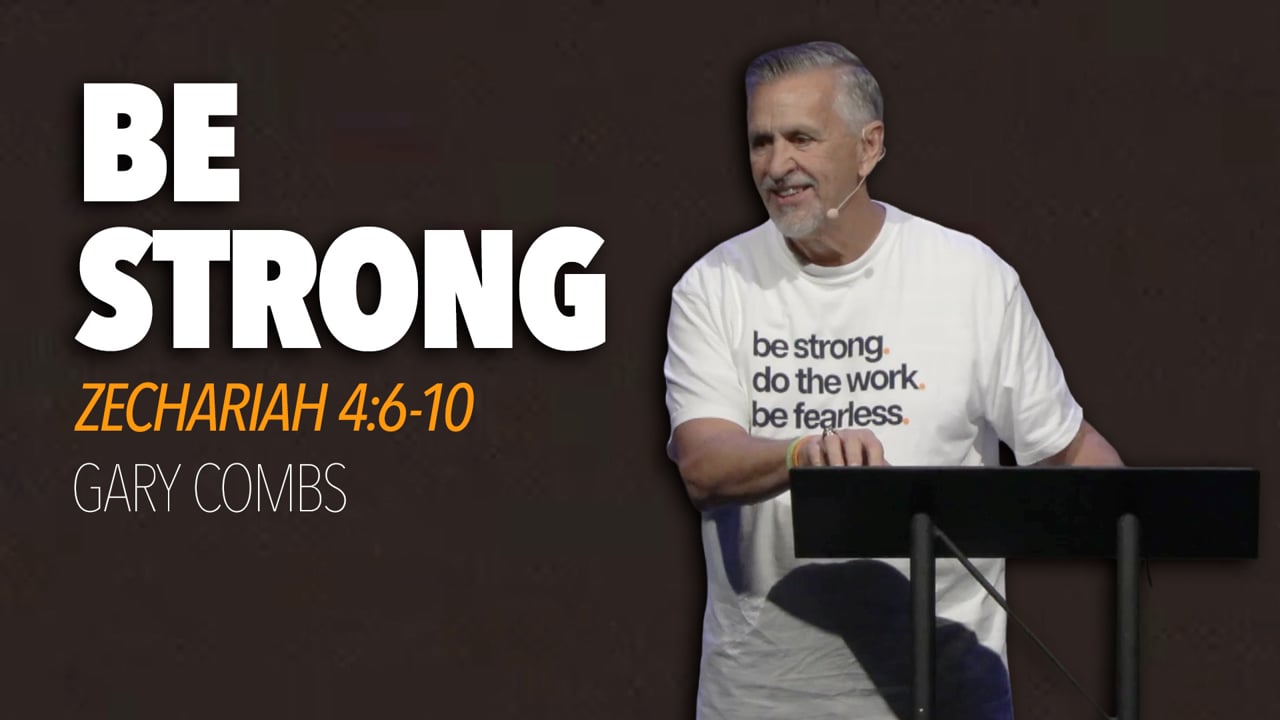
God’s work is accomplished by God’s power and strength and not by us. God’s work is accomplished by God’s power and strength, not by our strength, not by our power. As we dig into the book of Zechariah today, we’re going to entitle this message, “Be Strong.” We want to be strong in God’s Word, God’s power, God’s Spirit. Have you ever noticed something?
Have you ever noticed that it’s easier to start something than it is to finish it? It’s a lot easier to start. You know, we start off with great enthusiasm, with great ideas, great passion, but then obstacles come. Then we get tired. Then difficulties arise and progress seems slow and life gets busy and sometimes we just want to give up.
It’s easier to start a thing than it is to finish a thing, and that’s where we’re at in this book of Zechariah. I don’t know what’s going on in your life today. Maybe it’s marriage. It’s easier to get started in marriage than it is to finish well. Maybe it’s parenting.
Maybe it’s your career. Maybe it’s some other goal or some other item in your life. It could even be following Jesus. You got started with great enthusiasm following Jesus, but you’ve gone through a dry spell. It’s a lot easier to start things than it is to finish well.
But here’s what we’ll learn: . God doesn’t call us to accomplish His work according to our own strength. He calls us to accomplish His work through His strength, and we can learn to depend on His strength. In the book of Zechariah, the Lord gave the prophet a word to encourage and strengthen Zerubbabel, who was the governor of the returning exiles to Jerusalem. He gave him a word to strengthen him so that he could finish the work of rebuilding the temple. And I believe this morning we can be strengthened in the Lord to finish the work He’s called us to do.
As we look at the text today, I believe we can be strong in the Lord to finish well, and He gives us three reasons why this is so. So let’s dig in. Zechariah 4:1-14 (ESV) 1 “And the angel who talked with me came again and woke me, like a man who is awakened out of his sleep. 2 And he said to me, “What do you see?”
I said, “I see, and behold, a lampstand all of gold, with a bowl on the top of it, and seven lamps on it, with seven lips on each of the lamps that are on the top of it. 3 And there are two olive trees by it, one on the right of the bowl and the other on its left.” 4 And I said to the angel who talked with me, “What are these, my lord?” 5 Then the angel who talked with me answered and said to me, “Do you not know what these are?” I said, “No, my lord.”
6 Then he said to me, “This is the word of the Lord to Zerubbabel: Not by might, nor by power, but by my Spirit, says the Lord of hosts. 7 Who are you, O great mountain? Before Zerubbabel you shall become a plain. And he shall bring forward the top stone amid shouts of ‘Grace, grace to it!’” 8 Then the word of the Lord came to me, saying, 9 “The hands of Zerubbabel have laid the foundation of this house; his hands shall also complete it. Then you will know that the Lord of hosts has sent me to you. 10 For whoever has despised the day of small things shall rejoice, and shall see the plumb line in the hand of Zerubbabel.
“These seven are the eyes of the Lord, which range through the whole earth.” 11 Then I said to him, “What are these two olive trees on the right and the left of the lampstand?” 12 And a second time I answered and said to him, “What are these two branches of the olive trees, which are beside the two golden pipes from which the golden oil is poured out?” 13 He said to me, “Do you not know what these are?” I said, “No, my lord.”
14 Then he said, “These are the two anointed ones who stand by the Lord of the whole earth.” This is God’s word. Amen. We’re looking for three reasons we can be strong in the Lord to finish well. Here’s the first:
1. Because God’s Spirit empowers us.
It’s because God’s Spirit empowers us. This is the fifth of eight night visions in the book of Zechariah. He has all of these visions the same night, eight of them in a row. It was one of those nights for Zechariah the prophet.
And he has these night visions, which he does not understand what they are without the angel’s interpretation. And even so, as a reader, as a modern reader today, it’s a little difficult for us as well, isn’t it, until he gets to verse 6, and then all of a sudden our hearts are set aflame by what he says. What’s in verse 6? He says this in verse 6
In verse 6, he says,
“This is the word of the Lord to Zerubbabel: Not by might, nor by power, but by my Spirit, says the Lord of hosts.” Not by might nor by power, Not by your might, not your inherent strength, not your physical strength, and not by power, not by the resources that you have available to you, Zechariah, as the returning governor of the exiles. Now, Zerubbabel, by the way, is an unusual name. It’s not your usual Hebrew name, is it? Well, the reason is, it’s a Babylonian name.
He was born in Babylon. In fact, that’s what his name means. It means “seed of Babylon. ” That’s what Zerubbabel means. And so he’s the grandson of the former king of Judah.
King Jehoiachin was his grandfather. He would have been king if the Babylonians had not overthrown Judah, and if God had not given them permission to do so as a judgment against Judah. But now 70 years of captivity have gone by and here’s Zechariah, he’s not the king. He is the leader, but he’s not the king. And so he has power available to him, but it’s limited and he’s not able to complete the task of rebuilding the temple in his own power.
And this word, this vision comes to him, the 5th of 8 visions come to Zechariah the prophet. This word comes to Zerubbabel saying that it won’t be by your power and strength. It won’t be by your resources. You don’t even have to worry about the fact that you’re not the actual king. You would’ve been king, but you’re not.
You don’t have to worry about that because I’m gonna do it by my Spirit. I’m going to accomplish this task by my Spirit. I’m going to empower you to finish this. And you’re going to be able to say this, in verse 7, “Who are you, O great mountain? Before Zerubbabel you shall become a plain.”
What’s that mountain? Where’d the mountain come from in this story? The mountain is an obstacle that stands between the people of God rebuilding the temple. They’ve returned from Babylonian exile, but they’re little. They don’t have a lot of resources.
They’re not who they used to be. They’re kind of beat up, you know? They’ve been through some tough spots, and now here’s this mountain – there’s at least three things that are building that mountain up. One is, that they had started the temple rebuilding as soon as they got there, but then some of the local people got upset that they were doing this and they sent word to the king of Persia, King Darius, and said, hey, these Jews are back and they’re going to try to break away and rebel and build their own kingdom again. You’ve heard about them; go look it up.
And he puts a stop to the rebuilding of the temple. So they have political opposition. Boy, that’s a mountain. That’s a mountain. Then they had just the idea of the size of the task.
That’s just overwhelming. That’s going to take a lot of resources and we don’t have much and it’s going to be a lot of work and a lot of money and I don’t know if we can do this. And then the third thing they had was just kind of a spirit of discouragement and maybe that’s the worst one. When you get discouraged, you just kind of lose heart. If you read over in the book of Ezra, and Ezra is like the history book that gives you what’s going on during the time period of the prophets Haggai and Zechariah, which are contemporary prophets that are ushering the people and urging the people to rebuild the temple.
Ezra says that some of the old people, when they laid the foundation, wept because they remembered what Solomon’s temple looked like, the one that got destroyed. And they were thinking nothing will ever compare to the gold and silver and all the beauty of Solomon’s temple, and they wept not with joy, but with realizing it’ll never be the same. So they had this mountain of obstacles – political, under-resourced, discouragement. What are you facing today? What’s the mountain between you and God’s calling on your life?
What’s the mountain? What’s the obstacle? And here’s what God’s Word says, “Not by might, nor by power, but by my Spirit,that by the power of the Spirit.” You can say, who are you, O mountain?
And it says, before Zerubbabel, you shall become a plain. You shall be leveled. I’m going to level that mountain. It’s not going to be you, Zerubbabel. I’m going to do it.
I’m going to level that resistance, that obstacle. Verse 7, “…And he shall bring forward the top stone amid shouts of ‘Grace, grace to it!’” The top stone is the capstone of the temple. Zerubbabel, don’t lose heart. You’re going to set the capstone amid shouts of grace, grace to it, because it’s going to be God’s grace, God’s unmerited favor towards you. It’s not going to be your resource.
It’s not because you’re the king, because you’re not. It’s not because you’re powerful, because you’re not. It’s going to be me, and I’m going to get the glory, and the people are going to give me the glory, and they’re going to say, it was your grace, God. It was your grace. It was your free mercy that brought us this far.
The book of Psalms 127, says, Psalm 127:1 (ESV) “Unless the Lord builds the house, those who build it labor in vain.”
Parents, you’ll never be able to raise those kids without the Lord building your house. You’ll never do it in your own power. I was at a conference a couple weeks ago, and we took some leaders from our church, and a couple of leaders we took were my two sons, Jonathan and Stephen. We were mingling with other pastors from other churches, and a couple of pastors came up to me and they said, “I keep running into these people with the last name ‘Combs.’”
Are they related to you? I said, “those are my sons.” They said, get out of here. How did you do that? How did you get your own family involved in your ministry like that?
I said, I didn’t do it. God did that. Stephen said he was going to be the world’s greatest drummer and play in a rock and roll band and travel the world. That was his big plan. Jonathan was studying, watching all the ESPN news he could because he wanted to be a sportscaster.
My daughter Erin was the only one who said, I want to be a photographer, and turned out to be doing the things she said she was going to do. God did it. Stephen used to say, ‘I’m never coming back to Wilson’ and he came back. God did that, that they would come and be so caught up in this idea of reaching people with the gospel in eastern North Carolina that it would grab their hearts too. That’s what I told these guys, and they asked, what’s your secret?
I said, The Holy Spirit. Somehow I didn’t mess them up. That was my part. My part was I didn’t mess them up too bad, but God’s part was what you see.
What do you want for your kids? You can’t do it unless the Lord builds the house. What do we want for this house, for this church? Oh, we’ll labor in vain if we do it in our own strength, but if the Lord builds it, We can say “grace, grace to it.” It says in Ephesians, and we studied this just a week ago, Ephesians 3:20 (NIV) “Now to him who is able to do immeasurably more than all we ask or imagine, according to his power that is at work within us.”
We need to keep dreaming because God wants to do a work that causes you to say that God did it rather than yourself. Something bigger than you, something that only God could do. Now I told you this vision’s kind of strange. All these visions are a little bit difficult, but if you listen closely, you can get some keys to understanding it. It’s a lampstand that has seven lamps.
You can see it back in verse 2, and this lampstand is clearly the lampstand that would’ve been in the temple. This is clearly the lampstand that Moses was told by God to build with seven lamps. Number seven is the number of completion. God created all the universe, all the world in six days, and on the seventh day He rested, and so seven is the number of completion. It has seven lamps, and we know that the lampstand in the temple represents the very presence of God in the temple, and so that’s there, and then there’s two olive trees on either side, and olive oil is what the lamps, the seven lamps burned by. It was the fuel for the lamps. And then there were these unusual kinds of tubes that came and filled a bowl that kept the lamps continually burning so that they never ran out.
What is that? Well, you know, He says, ‘don’t you know?’ And I would’ve been just like Zechariah, ‘no, Lord, I don’t know.’ If you look down there in verse 10, He says, “These seven are the eyes of the Lord, which range through the whole earth.”
You need to go back to verse 2, to the seven lamps, okay? So that lampstand represented the eyes of the Lord, which is the omniscient presence of God who knows all and sees all. That’s the lampstand. He’s telling us so you don’t have to get too freaked out by the vision. What are these seven?
They’re seven eyes. If you go over to the book of Revelation, you’ll see that again as a representation of the Holy Spirit. This is a theme. In fact, Zechariah has a clear echo over here in the book of Revelation. And so what about those two olive trees though, Lord?
What are they? And you need to get down into verse 14, and he tells. “These are the two anointed ones who stand by the Lord of the whole earth.” Who are these two anointed ones? We have to keep reading. We don’t have time right now.
You keep reading Zechariah and you will find out that the two anointed ones are the High Priest Joshua, and the governor, Zerubbabel, and that God has anointed them to lead in the rebuilding of the temple. But more than that, all of this, this whole vision, this whole prophecy, as you’ll see more and more as you study the book of Zechariah together with us, that this is all pointing to its ultimate fulfillment in Jesus, who combines the high priest role, Joshua, Yeshua, the governor role, king role, as well as the prophet role. All three of those roles are united in Jesus. He’s the fulfillment of the whole. He’s the fulfillment of the lampstand.
He stands on the Temple Mount and He says, I, I am the light of the world. He fulfills the whole vision. And so we see here in Zechariah this encouragement, He says to him, you need to start rebuilding. Don’t worry about that mountain of obstacles. It’s going to happen by My power, by My Spirit, says the Lord.
What do you need to know about that today? Go back to that mountain again. Don’t focus on the mountain, focus on the Lord. But say, Lord, I need Your Spirit in me to overcome that obstacle so I can keep on keeping on for You. That leads us to the second reason we can be strong in the Lord to finish well.
2. Because God’s promises assure us.
The first is because we can be empowered by His Spirit. The second is: God’s promises give us assurance; they assure us. And now we’re down in verses 8 and 9, and as we look in verses 8 and 9, we see this, “Then the word of the Lord came to me…” and this is Zechariah. He says this, Verse 9, “The hands of Zerubbabel have laid the foundation of this house; his hands shall also complete it.”
That had to be a promise to Zechariah that just thrilled his soul. He probably thought, I don’t know, I’ve kind of given up. It had been 16 years since they had laid the foundation, and all those obstacles, especially the political one where Darius stopped work, just blew ’em up. It has been 16 years and they’ve given up hope. And then a word of the Lord comes and says, ‘you started it, I’m going to give you the power to finish it with your own hands.’
It says it twice. The hands of Zerubbabel laid the foundation of this house; his hands. In case Zerubbabel would’ve been saying, ‘maybe somebody after I die will finish it.’ He says to him, ‘no, your hands laid the foundation, your hands will finish it.’ Man, that promise had to mean a lot to him, that what God had begun, God would finish.
Verse 9, “Then you will know that the Lord of hosts has sent me to you. “ You’ll know that my promise is true. You’ll know that my prophecy is true, because it comes to pass. That’s the proof that what I said was true, that it happens.
This is what He told him, that his hand shall complete it. Let’s bring up this chart that’ll kind of give us a little timeline of what we’re talking about. The Jewish exiles were, they were exiled by King Nebuchadnezzar who overthrew Judah. They were there for 70 years. And then King Cyrus of the Medes and Persians gave them liberty to go home.
And they returned about 536 BC to Judah, and they began the initial work. They started laying the foundation, but those obstacles brought all the work to a stop. Sixteen years goes by, it’s 520 BC, two prophets appear on the scene. One is Haggai, who we studied deeply in 2025, and then the other was Zechariah. Haggai, He talked to the people about saying, ‘hey, it’s time to get back to work, it’s time.’
And then Zechariah gets a word, ‘it’s time to finish, time to finish.’ And they get that word in 520 BC; the work resumes. It only takes them four years to complete. Sixteen years it lay there, and then four years later they finished. It was a miracle.
They did what God said; they completed the task. God is faithful to keep His promises. What promises have you claimed from God’s Word for your life, for your family, for your situation? Those promises in God are more powerful than that mountain that is laying before you today, that mountain that’s overwhelming you today. Take your eyes off the mountain, put your eyes on the promises of God.
It says in
Hebrews 10:23 (ESV) “Let us hold fast the confession of our hope without wavering, for he who promised is faithful.” You see, that gives us hope and confidence when we look at the promises rather than the predicament. The predicament causes us to lose heart, but the promises keep us faithful. And He promises this to us, that the work He began in us, He’ll complete. It says in Philippians, Paul says to the church at Philippi, Philippians 1:6 (ESV) “I am sure of this, that he who began a good work in you will bring it to completion at the day of Jesus Christ.”
He’s working on us, He’s making us like Jesus, and He’s going to finish the work He started. Now this passage, chapter 4 of Zechariah, it’s very meaningful to me. It’s hard for me not to get very emotional about this chapter, and I’ll tell you why. Our church was ten years old, it was 2001, 2002. We started in 1991, November of ’91, like I told you, in our living room with a small group of people.
Seven people counting me and Robin. Within three months, it grew to three small groups. God did that. And then we launched in January of 1992 a Sunday morning service. Ten years had gone by;
it’s 2002. We were still portable, meeting at Forest Hills Middle School. Setting up equipment, tearing it down, driving it away in an old beat-up 1984 Chevy Boville van that we called lovingly, “Bertha.” And we set up and tore down every week. It was 2002 and we were still portable, and that was bothering me.
Lord, are we always going to be without a home, always setting up and tearing down? The other thing that bothered me was six months earlier in July of 2001, my mother passed away. My father died when I was 8 years old, and then my mama died, and it hurt me more than I realized. I couldn’t seem to get over the grief. I didn’t stop believing in God.
I didn’t stop trusting. I just hurt. In the midst of all that, we’re still portable. We’re working our heads off; we don’t have a lot of resources. We had kind of a disunity happen in the church, and some people left that were dear to me. You see, I get close to you guys.
I’m just like you. I have relationships. They didn’t even tell me bye. Some of them, some of them got saved here, baptized. Some of them I married and they just disappeared. I had to call them and find out where they were.
And that was the season. That was the mountain – February 2002. I told my wife, I said, ‘look, I got to get away for a little bit.’ ‘What’s wrong, honey?’ ‘I need to talk to God about some things.’
I didn’t want her to be discouraged with me. And so I took a case of bottled water, a legal pad, an ink pen, and my Bible and checked myself into an old Best Western that’s been torn down now at Atlantic Beach. There were cheap rooms at the beach in February.
I checked in. I turned the TV around backwards and unplugged it because that was the only screen you had to worry about in those days. I didn’t want a distraction. I put the “Do Not Disturb” sign on the doorknob and unplugged the telephone in the room.
I had two questions for God. ‘God, can I stop being a pastor, please, and just go back to working in the corporate world?’ I was good at that. Apparently I’m not good at this.
‘And along with that, can I move back to Virginia?’ I’m not from here. I’m just tired of being here. My family lives in Virginia and I was missing my mom, you know, and I just wanted to go back to the mountains, see the Blue Ridge again, you know, live up there in the cool weather where the state bird is not the mosquito. You know what I mean?
My second question was, ‘okay, Lord, if I can’t quit the ministry, can I quit this church and go to work for another church and be the #2 guy? I think I’d be a good #2 guy.’ Let the senior guy lead because apparently I don’t know what I’m doing and he could catch all the arrows that I’ve been catching lately and that would be nice too. Those were my two questions. So I began to fast and 36 hours later, a day and a half later, I hadn’t heard not one word from the Lord and now I had a third question.
‘When can I stop fasting?’ Because my stomach is really growling, and I’m a coffee drinker, and now I’ve got a splitting headache from a caffeine withdrawal. Still nothing. On the second day, I’m out on the beach, I’m walking, it’s freezing cold, there’s no one else on the beach. I’m walking. I’ve got on a hoodie, I’m walking, saying ‘Lord, please, if you don’t talk to me, I’m just going to make this decision on my own.
I don’t know what you want me to do.’ And I had this sense, this word came to me that I was supposed to go back to the motel and read Haggai and the book that followed. Well, that’s Zechariah. Is that me, Lord, or is that you? That sounds like my voice in my head.
I’m just getting desperate for something. I’m making up stuff now. Is that you, Lord? Is that me? Well, I’m going to go on what I know.
I started reading Haggai; it didn’t do anything. I’d been there before. I knew Haggai really well. I didn’t feel anything. I read Zechariah chapter 1, chapter 2 and chapter 3.
This is some weird stuff, Lord. There’s some visions here. I don’t know. Why am I over here? And then I hit chapter 4.
I told you this is an emotional chapter for me. When I hit verse 6, “…not by might nor by power, but by my strength…” I just started crying
and I knew that was the word I was supposed to hear. But, my name’s not Zerubbabel, I’m Gary.
This was for Zerubbabel. And I began to think about it .I learned in seminary that prophecies have an immediate fulfillment, an immediate application for the setting they were given in. Then they are ongoing. In other words, it doesn’t cease to have meaning; it has an ongoing application. Then it has an ultimate fulfillment in Jesus because Zechariah, in the line of David, points to the Son of David, Jesus, ultimately who actually laid the foundation as the cornerstone of the church, and He’s the capstone of the church. It’s being fully fulfilled in Jesus.
But what about the in-between? Can Gary jump in the in-between? And I felt like the answer was yes. Lord, is that You? And I felt like it was.
It wasn’t me. I wouldn’t have been over here on my own. In this weird, visional, crazy olive trees and lampstands. I wouldn’t be over here on my own. I’d be somewhere where I could understand it quickly.
It must be you, Lord. And then I got to this part where you’re going to set the capstone and your hands started it. And I thought, ‘yeah, 10 years ago. It wasn’t 16 like Zerubbabel, but it was 10 years ago and we still don’t have a house. We don’t have a home.
We’re still portable.’ And so I felt like not only can I not quit the ministry, I can’t go back to Virginia, and I have to go back to Wilson and keep working at this church. That only left one question, ‘When can I stop fasting?’ Two days in, and I thought, well, might as well stay in Zechariah, keep reading and see if I can get an answer to that one.
It’s been working so far. And I got over to chapter 7, where it said, ‘I’m tired of this fasting you’ve been doing, ‘ which is my paraphrase, but I asked, ‘do we still have to fast in the fourth and then the tenth and all, you know, these different months?’ And he says, ‘no, I want your fasting to turn into joy.’ I’m gonna eat breakfast tomorrow.
And so on the third day, after three days of fasting, I had breakfast with coffee.
Gary, why are you telling this story? I have to tell you, I’m a little fearful to share it with you because it’s too close to my heart. And when I tell you something this close to my heart, I don’t know how you’ll take it.
But I’ve just gotten to where I don’t care what you think. Or at least I care less than I used to about it. I mostly care what God thinks. And he’s promised me something that I’m already seeing. I haven’t had to wait.
My hands and my wife’s hands and some of you that got on board back in 1992, raised your hands a minute ago when Robin asked about the blue cards. You’ve been on the journey. And some of you got on in ’92, ’93, ’95, ’98, 2002. Some of you got on board today. It’s your first time here today and the journey’s still going and God’s building this church. It’s not my church and it’s not your church. It’s HIS church, and He’s going to finish His church.
I got to be on the journey, and so did you. I didn’t quit. Please don’t quit. Don’t give up. He keeps his promises.
3. Because God’s perspective encourages us.
Take your eyes off the mountain, put them on the Lord and his promises. And that leads us to the third reason we can be strong in the Lord to finish well: Because God’s perspective encourages us. His perspective encourages us. What’s his perspective? Well, he says, in verse 10, “For whoever has despised the day of small things shall rejoice, and shall see the plumb line in the hand of Zerubbabel. “These seven are the eyes of the Lord, which range through the whole earth.”
Remember those older people that cried when they saw the foundation being laid and they realized it’s never going to be as grand as Solomon’s Temple? It’s going to be simple. It might just be an old movie theater that somebody bought and cleaned up. It might be something like that, you know. It might be something simple.
They cried and they despised the day of small things. They said, ‘we’re just little. We are little in power. We are little in resources. We don’t have our own king.’
We’re just little. And you know, we used to tell ourselves that in this church. We used to say that, you know. We don’t have a lot, but we do the best we can. And you might say, ‘well, that sounds right. You should think like that.’
Well, not if you forget that you have a big God. Not if you start telling yourself that we can’t dream anything, we can’t start anything, we can’t try anything because we’re little. Then you start making decisions based on yourself, on your power, your strength, rather than the Spirit of God, rather than God’s promises, rather than God’s perspective. Here’s God’s perspective: He looks at them and He says, ‘I hear you down there saying that you hate being little.
You despise the day of small beginnings. You hate being little. You say it all the time.’ We can’t help it, we’re little. But God is big; that’s HIS perspective.
His perspective is that “I can do all things.” Here’s all you have to do, Zerubbabel; pick up the plumb line. Do you know what a plumb line is? It’s the thing that you use so that you can make the building that you’re building square.
You take a string, you put a weight at the bottom, the gravity causes it to go 90 degrees. That’s how you know that a building is 90 degrees. He says that if you take up this instrument of construction, the people are going to rejoice that Zerubbabel lost his discouragement and started believing in God again. He took his eyes off the mountain and started putting his eyes on the majesty of God.
And so the people are going to rejoice before they see the building just because Zerubbabel believed again; because he didn’t quit. He kept going and it caused them to have heart. Was Zerubbabel “all that and a bag of chips?” No, it’s because God gave him a new perspective – Zerubbabel, your hands will finish this.
You laid the foundation, the cornerstone, you’ll set the capstone. And the ultimate fulfillment is Jesus who’s building His house.
In fact, the book of Zechariah echoes throughout the New Testament. So many Messianic prophecies in this book. It’s so amazing. God has a higher perspective than I do and a higher perspective than you do. He can see all.
Isaiah says it like this. He says, in Isaiah 55:8–9 (ESV) 8 “For my thoughts are not your thoughts, neither are your ways my ways, declares the LORD. 9 For as the heavens are higher than the earth, so are my ways higher than your ways and my thoughts than your thoughts.”
speaking on behalf of the Lord, my thoughts are not your thoughts, neither are your ways my ways, declares the Lord. For as the heavens are higher than the earth, so are my ways higher than your ways. And my thoughts than your thoughts. Get God’s perspective.
Lift your eyes, get God’s perspective on the situation you’re facing today. Fill in the blank, what is it? What’s the name of the mountain right now that’s before you? Take your eyes off of it and look up. Get God’s perspective. That mountain is nothing.
He says,
‘that mountain is flat to me.’
God chooses the small things to do great things. He always does. And being little can be an advantage if you admit it. God, I need you desperately. I need you.
It says in 1 Corinthians 1:27-29 (ESV) 27 “But God chose what is foolish in the world to shame the wise; God chose what is weak in the world to shame the strong; 28 God chose what is low and despised in the world, even things that are not, to bring to nothing things that are, 29 so that no human being might boast in the presence of God.”
It’s good to be little if you have a big God.
It’s okay to be little if you have a big God. It’s not okay to say you’re little and forget God though. That’s a place of deep discouragement.
My wife referred earlier to loving the phrase, “But God.” You can be little, “But God.”
You can say, ‘God, you’re big. You’re bigger than this mountain that I’m facing today.’ Who could imagine what started in a living room with 7 people with rabbit ear antenna on top of the TV and me wearing my 1980’s aviator glasses. I couldn’t afford to go to the eye doctor to get contacts, so I had to get my old prescription out. That’s what it cost. Those kinds of little things, little sacrifices.
We didn’t suffer that much, but it felt like it at the time, in order to plant this church. Who could have thought that today we would be spread out over two campuses, seeing hundreds and hundreds of people over the last 35 years come to Jesus, get baptized and saved? Who would have thought? I’m so glad God wouldn’t let me give up.
I’m so glad he brought you here. I wouldn’t know you, you wouldn’t know me. “But God, but God, but God.” His perspective. It required sacrifice though, and I think it’s important for me to teach generosity. It’s overlooked and it’s one of the things that causes so many American churches trouble.
Some get in the wrong ditch and they overdo it. They talk about it too much. But ours has been more like we tend to not talk about it enough. Generosity is one of the marks of mature discipleship. A true disciple of Jesus, is that we’re generous. After all, “God so loved us that he gave.
He gave his only Son.” And it’s a mark of God, this generosity. So I want to teach you really quickly. It’s in your bulletin. It’s called a “generosity ladder.”
Where am I at today in my generosity? Am I little, really little? Are my finances pretty messed up and I need to get things organized under the Lord? Then why not start at the first level and say, ‘I’d like to be a first-time giver. I’ve never given at church. I’ve never been a giver.
I’ve always felt like I was too little. I didn’t have enough for myself, but could I trust God with a first step?’ That’s where some of you are this morning. That’s okay. Take a first step, make an initial gift to the Lord and watch what God begins to do.
Say, ‘I need to give God that mountain of poor finances, of little finances.’ Being a consistent giver would be the next step. And that’s where you start. Or, you might say, ‘you know what I’m going to do? Because I’ve trusted God with an initial gift, I’m going to give a percentage.’ Some of you aren’t ready to be tithers.
Your finances are too messed up. I get that. It’s going to take you a little while to get those things straight, but start with 1%. Start with 2%. Get started and be a consistent giver.
Does that make sense? That’d be a second step. And that’s where some of you are today. The third step is an intentional giver. You’ve got it now; you’re now a tither. You’re a regular giver, and you’re starting to feel like, ‘hey, you know what I found out?
I can live on 90% better than I could 100%. It just seems like God sews up the holes in my pockets whenever I’m just being generous.’ And it changes your heart. It loosens the grip of greed and materialism from your heart as you just release. It’s part of your discipleship. It helps you grow.
And then the next step, and this is the step that my wife and I have been on for some time. We’re in our late 60s now, so it took us a little while to get here because I’m kind of hardheaded, I guess. It took us a little while, but that’s where we are. We’re able to give over and above our tithes and offerings. We’re able to give sacrificially, and God has enabled us to do that. And so we’ve given very boldly to “It’s Time.”
And we’re giving it. I’m not going to name the number, but when I wrote it down on my commitment card last year, it scared me and my wife a little bit. Where’s that going to come from? And it’s partly why I keep telling her, ‘honey, you got to keep working.’
She keeps asking, ‘when can I retire and just be a grandma?’ Well, we need to keep working because we want to keep giving. And so that’s sacrificial. That’s where you decide, ‘I’m going to work a side job. I’m going to sell something.
I want to be part of God’s evangelistic work in Eastern North Carolina, planting more churches and reaching more people with the gospel.’ And then, there is the legacy giver, that’s someone who’s planning what will happen to what they leave behind when they pass away. Now I’m still here, so I can’t be that yet, but I want my wife and kids to know I’m not going to leave everything behind to them, because I’m going to let God help them and they’re going to be okay. They’ll get a little something.
I might give it to the grandkids anyway instead of them, but I’m going to make sure I leave something for the gospel. If God allows me to have anything left over, if he allows me to keep working, I can’t believe I’m even saying that, because just a few years ago I would say, ‘it’d be nice to get paid once in a while.’ But now God is blessing us. I want to be able to leave a legacy for my kids and my grandkids and my great-grandkids at church, not just in my house. Where are you on this generosity ladder?
I challenge you to think and pray about that before the Lord. Church, as we finish this “It’s Time” journey together, as we, over these next four weeks, think and pray about this, take that commitment card home. Take it and hold on to it for two weeks. Pray about it. Do the journey guide.
Read the scriptures. Pray for whatever number God gives you over and above your normal giving, that’s the number you’ll turn in on November 15th. And then whenever that number is accumulated, we’ll announce it to the whole church on November 22nd. And whatever that number is, we’re going to thank God for it because that’ll be God’s number, not my number, not your number.
It’ll be what God told us and then we’ll give it faithfully so that we finish well. I want us to keep praying, ‘God, what do you want to do in me and through me? God’s Spirit is the one who empowers us. It’s God’s promise that enables us, encourages us, and it’s God’s perspective that helps us see reality with more clarity. That really encourages us.
And when it’s all said and done, we’ll say grace, grace, grace. God’s unmerited favor enabled us to do this. And speaking of grace, the greatest grace gift that we have is Jesus, who died for our sins. He was buried and raised again on the third day, lives today and is coming again soon. If you don’t know him, I pray today that you’d give your life to Jesus.
Let’s pray. Lord, thank you for your word. Thank you for this vision that you gave Zerubbabel and Zechariah to encourage them to get back to work on your house. But more than that, we thank you for Jesus because it’s his house and he’s building it. He said, “Upon this rock I will build my church.”
And so, we bend our knees to you, Lord Jesus, knowing that you are the one that builds your church. You are the cornerstone and you will set the capstone someday. And Lord, in the meantime, thank you that we are living stones, that we are part of your church, and that you’ve called us to be servants in your church. And so Lord, I thank you for that privilege.
Lord, I pray for that one that’s here this morning that’s never committed their life to you, to be part of your body, to have you as Lord and Savior. I pray for you right now. You can pray with me right where you’re seated, right where you’re listening. If it’s your heart’s desire to come to Christ, pray like this. Dear Lord Jesus, I’m a sinner.
I believe that you died on the cross for my sins and that you were raised from the grave, that you live today. Come and live in me. Forgive me of my sin. I want to be adopted into your family and follow you all the days of my life as a child of God. Thank you for saving me.
And if you prayed that prayer of faith believing today, it’s the Lord who will save you. That’s his promise. Now, Lord, be with us now as we make these commitments together, the most important being following you, but after that, to be generous like you. Show us the way, Lord. In Jesus’ name, amen.