Transcript
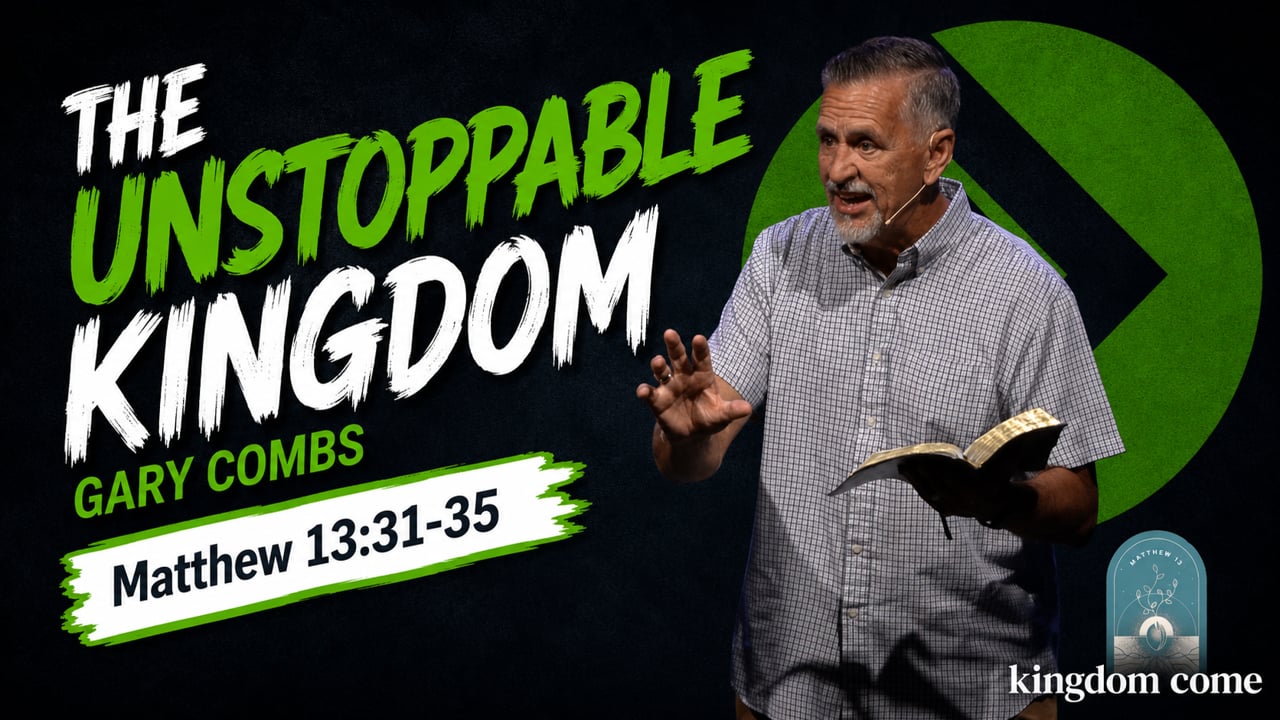
”Kingdom Come,” that’s our series. We’re in part 3. We’re preaching through the parables that Jesus taught in Matthew chapter 13. And today we’re going to be looking at two parables that really function in a very similar fashion. We’ve named this series based on the Lord’s Prayer, the Lord’s teaching prayer, that He taught in Matthew chapter 6.
And we all know this prayer, “Our Father which art in heaven, hallowed be Thy name. Thy kingdom come, Thy will be done on earth as it is in heaven.” He taught His disciples and He teaches us to pray “kingdom come” prayers, to pray for the kingdom to come. And every time we pray “kingdom come” prayers, we’re praying for the rule and reign of God to come to this world and to come into us personally. We’re not praying my kingdom come, we’re praying Thy kingdom come prayers for Jesus’ kingdom to come in us.
But the way Jesus talks about the kingdom creates a surprising tension for those that hear these parables and hear Him talk about the kingdom, because He says that the kingdom is at hand, the kingdom is near, pray that the kingdom would come, pray kingdom come prayers, the kingdom is already in the midst of you. He says that the kingdom is about to come upon you, and so He teaches this “already/not yet” of the kingdom, that it’s here, it’s present and it’s coming, And so the kingdom was near, it’s present and it’s coming; all of this describes the reality of the kingdom, but it also shows that it comes in a surprising way. It’s really a great surprise. In fact, I almost named this sermon instead of an “Unstoppable Kingdom,” a “Surprising Kingdom,” because these two parables describe why it came in such a surprising fashion. But more than that, it teaches that it’s unstoppable, so I finally landed there, but it could have been surprising. It’s surprising because many people expected something spectacular, something immediate.
They expected to see castles and thrones and armies, and instead they heard a parable about a tiny mustard seed, that the kingdom would come like a mustard seed. They expected something obvious, something public. Instead, Jesus describes something that works quietly and obscurely like leaven in a lump of dough. They expected the kingdom to arrive with overwhelming power all at once, and Jesus revealed that the kingdom would begin small, work unseen, and advance gradually, and yet it would ultimately extend its influence to the whole world. Its beginning would not reveal its greatness at the ending.
And so that’s the surprising nature, and that creates a challenge for us because we’re tempted to judge the kingdom of heaven, the kingdom of Christ, by its present state, the way it seems to appear to us now. We tend to entrust what’s big, visible, powerful, measurable. So when the church seems small compared to the powers of this world, when the culture seems increasingly resistant to the gospel of Jesus, when the work of God appears to be slow and hidden, we can begin to wonder, is His kingdom really advancing? Is His kingdom coming? But Jesus warned us not to worry about small beginnings and small influences.
The kingdom may begin like a mustard seed and work like leaven, but it is an unstoppable kingdom through His Son Jesus. In Matthew 13:31-35, Jesus taught two parables. And it revealed the surprising manner in which the kingdom of heaven enters and advances in the world. And I believe that we can trust that the kingdom of Christ is coming and it is unstoppable. And as we look at the text today, I think we’ll see three reasons why it’s an unstoppable kingdom.
So let’s dig in,
Matthew 13:31-35 (ESV) 31 He put another parable before them, saying, “The kingdom of heaven is like a grain of mustard seed that a man took and sowed in his field. 32 It is the smallest of all seeds, but when it has grown it is larger than all the garden plants and becomes a tree, so that the birds of the air come and make nests in its branches.” 33 He told them another parable. “The kingdom of heaven is like leaven that a woman took and hid in three measures of flour, till it was all leavened.” 34 All these things Jesus said to the crowds in parables;
indeed, he said nothing to them without a parable. 35 This was to fulfill what was spoken by the prophet: “I will open my mouth in parables; I will utter what has been hidden since the foundation of the world.” This is God’s Word. We’re looking for three reasons we can trust that Christ’s kingdom is unstoppable. Here’s the first reason:
1. Because its small beginnings cannot limit its ultimate growth.
Its small beginnings cannot limit its ultimate growth. Jesus compared the kingdom to a mustard seed, a proverbial way of describing tiny things in His day. The mustard seed is the smallest seed of all the plants that you plant in the garden. And then it’s a simile here He gives because it says, “The kingdom of heaven is like a grain of mustard seed…” He doesn’t say the kingdom of heaven is a mustard seed, He says it’s like a mustard seed.
Do you remember your studies in high school of literature? “Like” and “as” are both keys to show you that we’re dealing with a simile. This is a metaphor for the kingdom. The kingdom of heaven is like a grain of mustard seed that a man took and sowed in his field. And so He’s comparing its smallness. See, this is a surprise to the people of Israel.
There were really two threads of Messianic prophecy in the Old Testament. One was of a conquering King, and that’s what they were looking for. But the other thread that they seemed to miss was of a suffering servant. And so we see that line of prophecy in places like Psalm 22 where it begins in verse 1, “My God, my God, why have You forsaken me?, which Jesus says on the cross,
saying the very words that David wrote down. And it has a line in Isaiah 53 that speaks of the suffering servant. And so they seem to overlook that line of Messianic prophecies, but here He’s saying it’ll be like a tiny thing, and they thought it would come big, but it comes tiny. But He says to watch this though, it doesn’t stay tiny. He says,
“…is like a grain of mustard seed that a man took and sowed in his field.”
What’s the field? That’s the world of humanity, that’s the world that this gospel seed, that this kingdom comes through the King Jesus and it will grow into the largest plant in the garden. Now, this is not the mustard plant that we see in the United States that grows to a bush, this is a larger version of it that we see in the Middle East East that grows to 20 feet tall and even larger. So this tiniest seed grows to this tree. And so this is a small to great metaphor.
Indeed, in the Greek we have smallest, which is mikros in the Greek, and, and when it has grown larger, which is megas in the Greek. So it grows from mikros to megas, from micro to mega. And so He’s getting their attention and they all know this because this is an agricultural people; we know. He says that’s what the kingdom of heaven is like. It comes really small, you can barely see it, but it grows into a tree.
In fact, it grows so big that birds will build nests in its branches, showing the size of it. Now, there are at least three ways as you study the way theologians have looked at the birds that are making the nests in the branches. Some just look at the previous sower of the seed, of the sower parable of the four soils, and in that parable, the birds that came along and ate the seed represented evil, represented the evil one. This is probably saying that the kingdom will also have evil in it. It’ll have a mixture.
And they kind of view it, the birds, because of what they saw there. There’s another group that just looks at it and says, it’s just showing how big the tree is. The tree gets so big that it can support birds in their nest, and just from a little tiny seed to how big it is. I kind of fall into the third camp, which I’ll mention now, and it’s influenced by passages like this that you find in Ezekiel 31:6 (ESV) “All the birds of the heavens made their nests in its boughs; under its branches all the beasts of the field gave birth to their young, and under its shadow lived all great nations.”
I kind of lean towards the idea of these birds and their nests, and nests are abodes, like little places of dwelling. I think it’s a positive picture. I kind of land in that camp that it’s the nations of the world, that it’s the Gentile nations, that it started small in Israel and it grew out until it moved out into the nations so that Jesus gives us the Great Commission, “Go therefore and make disciples of all nations.” And the Greek word is ethnos, go and make disciples of all ethnos, of all ethnic groups. And so, you know, Jesus doesn’t tell us that part.
He doesn’t tell us the meaning of the birds, but that’s where I lean. I lean towards that idea that it’s a picture of how the kingdom of God will grow out and begin to affect all the nations of the world. Here’s what I’m seeing here in this though. Why is He telling this parable to this people? It’s because the kingdom is coming in a way that they are surprised.
It’s coming little. Do you feel little today? Do you feel small? Do you feel like you’re not all that? Guess what?
God can use you. Do you feel big? Do you feel powerful? You feel like, yeah, I’m all that and a bag of chips.
Well, God’s got another plan for you. He’s gonna have to make you small before He can use you, because God loves to use small things and little people because then He gets the glory. This is what He says to Zechariah. Zechariah was born in the line of David. He would’ve been king, but because Jerusalem had been overthrown, Israel had been overthrown by King Nebuchadnezzar of Babylon, and they’d carried the people into exile, destroyed the temple and had torn down the walls.
Zechariah is part of that group that returns to Israel after 70 years of exile, not as a king, but as a governor under Cyrus, the king of Persia that had overthrown King Nebuchadnezzar. And he returns and they immediately start laying the foundation for the temple, but then there’s a lot of trouble, there’s a lot of distraction, and the temple foundation just sat there for years and they didn’t do anything else on it. And so Zechariah, he’s discouraged and the people are discouraged. In fact, some of the older people that remember Solomon’s Temple, they were just weeping thinking it’ll never be as good, it’ll never be as great as Solomon’s Temple, and they were feeling really small, especially Zechariah, he really needed encouragement. And so God says this to Zerubbabel through the prophet Zechariah.
He says, Zechariah 4:10 (NLT) “Do not despise these small beginnings, for the Lord rejoices to see the work begin, to see the plumb line in Zerubbabel’s hand.” And so God spoke through the prophet Zechariah to tell the governor Zerubbabel to not despise the day of small beginnings. Don’t look at this, what’s so little, it’s so insignificant, because God rejoices in this day to see you holding the plumb line, which is an instrument of making sure everything is squared. It’s an instrument of a building program. This verse has always meant a lot to me ever since the year 2002.
In 2002, it was only a few months in, February of 2002, I was feeling so discouraged about our church. The church was ten years old. We just experienced our ten-year anniversary, and we were going through a tough season financially. My mother had died only a few months before that. She died in 2001. She was only 66 years old.
9/11 had happened that year so that there was a kind of discouragement in our people and in the nation. There was an economic kind of discouragement and we were discouraged in the church. We were still portable after ten years.
I just felt little. I wanted to quit. Part of it was I was grieving, part of it was how small we were after ten years of labor, and I just felt like such a loser, like maybe I’m not cut out for this. Please, Lord, let me quit. I went away for three days with a case of bottled water, a legal pad, a pen, and my Bible. I said, God, I’m gonna fast until you speak to me.
I need you, I want to quit, I want to go back to the hills. I’m not from the flatlands down here. You shipped me down here, I want to go home. Have you ever been there? Have you ever been where you wanted to quit,
you wanted to go back? You wanted to go back to Egypt? The wilderness is hard. I wanted to give up. And I felt the Holy Spirit lead me, I was reading through the Bible, I felt him lead me to Zechariah and I’d read the first three chapters and I was like, are you sure you told me? Maybe I told myself I was supposed to be reading Zechariah. But then I got to chapter 4 and I felt the spirit speaking to me, as I got to the passage where it says, Zechariah 4:6,
“Not by might, nor by power, but by my Spirit, says the Lord.” I felt tears coming to my eyes. He says to Zerubbabel, you laid the foundation and you’ll set the capstone.
And he says, “don’t despise the day of small beginnings.” Lord, are you telling— are you allowing me to hear what you said to Zerubbabel, to hear it afresh? It had a meaning for Zerubbabel. It had a meaning for me. God’s Word has an ongoing meaning for us, friends.
You can enter the story at places and ask God to speak to you. I felt like I had to go home. I had to go home to Wilson and go back to work. It was really clear to me, don’t give up, don’t despise the day of small beginnings. There was a season during the exile where there was a young man named Daniel that began to work for King Nebuchadnezzar.
He was gifted with the ability to interpret dreams, and Nebuchadnezzar had a dream, and he dreamed of this image of a great king that had a golden head, bronze body, legs of iron and then feet of iron mixed with clay. And then he saw a stone that turned into a mountain and broke the whole thing down. And it was more complicated than that, but I don’t have time to go into all that Daniel talked about in Daniel chapter 2. But here’s the key verse I want you to take note of, Daniel 2:35 (ESV) “But the stone that struck the image became a great mountain and filled the whole earth.”
That was a prophetic word that God spoke through a Gentile king named Nebuchadnezzar and was interpreted by the Jewish prophet Daniel. That was a prophecy of the kingdom of heaven and of the coming King, that it would come little, but it would turn into a mountain and it would overthrow all the kingdoms of the world.
That’s what Jesus is telling them in this parable, but it’s going over most of their heads. He says it’s going to come and it’s already come right now because the King has come, King Jesus, but it’s coming like a mustard seed, but it’s going to grow into the biggest tree in the garden.
Be careful not to despise what looks small when Christ is at work. Be careful not to feel that you can’t attempt this because God, He loves to use little things and little people to accomplish great things. It starts, don’t despise the day of small beginnings. We can become discouraged when a gospel conversation seems to accomplish little. We can give up praying for that one that we’ve been praying for because we don’t see any change.
But God’s at work and his kingdom is growing and it’s unstoppable. Small beginnings are no obstacle to a sovereign God. This is the first reason that he gives these parables, the first reason we can see that his kingdom is unstoppable. Here’s the second:
2. Because its hidden working cannot prevent its rising influence.
Its hidden working cannot prevent its rising influence. Jesus will shift now from the field to the kitchen. I think He must have seen some women in the crowd. And He said, let me put a woman in this parable. Let me go to the kitchen where the women are making bread.
In verse 33, He told them another parable. “The kingdom of heaven is like leaven that a woman took and hid in three measures of flour, till it was all leavened.” Here we have another simile. It’s like leaven. What is leaven? It’s yeast. It could be baking powder.
It’s a substance that causes dough, flour mixed with water, to rise. And people who make bread know this. It only takes a little to leaven the whole lump. It only takes a little, just a little bit, to leaven the whole lump. He’s using something, and he puts a woman in this parable just for the ladies.
He doesn’t want them to feel left out in the crowd. “The kingdom of heaven is like leaven that a woman took and hid,” Unusual choice of words; “hid.” We’ll see later why I think He chose this. It’s appropriate, but it’s somewhat a metaphoric word to use in the making of bread.
You would normally say, well, they sprinkled it in and then they folded it in, or they kneaded it in, but He used the word, “hid.” We’ll see in a little while why, because He brings that word back, but in a way it is hidden because it only takes a little and you don’t just sprinkle it on top where it’s visible and you just let it lay there. No, you fold it in, you knead it in until it disappears. And the idea of “hidden” here is not something like the lady was being sneaky, I’m gonna slip this in here, nobody’s gonna see this, but it’s the idea, no, that’s how you do it. That’s how you make bread.
And so the ladies would like the word, “hid.” I wonder why you used that. But that’s exactly true. You can’t see it. Once you’ve worked it in, you can’t see it.
And then you set it aside and it begins to rise. It goes to work even though it’s invisible in its activity. He said the kingdom of heaven is like that. And then He’s very particular about the measures of the flour. Many have really worked hard on this:
“hid in three measures of flour.” The word, “measures,” seems to come from the Greek equivalent of the Hebrew seah. Three seahs of flour, and three seahs makes an ephah. Well, now we all know how much this is, right? Well, you have to know what a seah and an ephah is, and an ephah is close to fifty pounds.
Now the ladies are waking up. I’m hearing from some of the ladies that make bread. I know my sister over here makes bread. She’s given me some loaves from time to time. She’s a great bread maker, baker.
I think that what you call a bread maker is a baker. It came to me finally. And so this idea of this little bit of yeast to three seahs, 3 measures of flour, the ladies in the crowd would’ve thought, whoa, that’d feed over 100 people. I’ve never made that much bread. That’s the thing about parables that we’ve talked about; there’s always something about the parable that’s very recognizable, but at the same time, a little off.
Nobody makes that much bread unless they’re making it for the royal household or something. And three measures, that’s a lot of flour. But again, it’s lesser to greater. It’s a similar parable, but here it’s talking about something slightly different. Now, may I say to you that many see leaven, and in truth, as you read the Bible, Old Testament to New Testament, every other place I look at leaven except for this parable, it’s in the negative sense.
Leaven is a negative influence, like sin or temptation, that if you put one grumbler in a group, everybody starts grumbling. If you have one sin in your life, it influences your whole life. And so leaven is almost, throughout the Scripture, used in a negative sense, and in fact, Paul is talking about leaven in that way in Galatians chapter 5, where he says, Galatians 5:9 (ESV) “A little leaven leavens the whole lump.” He’s talking about it like that in the negative sense, but here I believe it’s in the positive sense. And the reason I believe it’s in the positive sense is because Jesus says, in verse 33, “The kingdom of heaven is like leaven…”
I’m pretty smart, see? I can just read that. Oh, He’s not saying that the kingdom of heaven is sinful, He’s not saying it’s negative. So here is the unique place in all the Scripture that He’s using leaven in the positive sense. You’ll see it again in Luke chapter 13, but it’s the same parable.
That’s the only two places in Scripture that I see leaven being used in the positive sense, because here leaven is a metaphor for influence, for influence. And we wonder, is the church influential? Is the church like salt? Is it like light? Is it like leaven in the city of Wilson?
Is Eastgate leaven? And when I talk about Eastgate, I’m not talking about this building, I’m talking about us. As we go out from this place, are we like leaven in our families, in our neighborhoods, in our schools, in our workplaces? Are we influencers? And it might look small, ’cause it is small, but it grows.
That’s the way he’s describing the kingdom here. Our inability to see God’s work does not mean that God isn’t at work. In Ecclesiastes, Solomon talks about this, he says, Ecclesiastes 11:5 (NLT) “Just as you cannot understand the path of the wind or the mystery of a tiny baby growing in its mother’s womb, so you cannot understand the activity of God, who does all things.”
You can’t see the baby until 9 months go by, but God is forming that child within the mother’s womb. The mother is aware of it more than anybody else. She occasionally will say to the husband, hey, look at this, put your hand right here.
But we wait to see what God has done in secret. As the prophet says, I was formed in a secret place, speaking of the mother’s womb. God’s at work. Think about it and how influential His work is. So don’t be discouraged that you don’t see instantaneous results when you pray for someone or when you share your faith with someone.
God’s at work. We pray for a child who seems far from God. We pray and share the gospel with a friend and they show little response. We teach Scripture week after week. I feel that as a pastor and many of you are teaching your children, you’re teaching in your homes, in our community groups, you teach and you wonder whether anything is changing.
Jesus reminds us that the kingdom is working long before its effects become visible.
The kingdom is expanding, it’s rising in its influence, but its activity is mostly unseen until it appears. And so we see it when it appears, we see life change. One of the really challenging things about being a pastor or a parent is how long we must labor and care before we see what we’ve raised, who we’ve discipled, what the Lord has produced in us and through us. You have to not become weary in well-doing, as the scripture says. You have to keep on keeping on.
And that’s why I think I like working in my yard so much. It hasn’t been as much fun this summer because of the drought, but I like working in my garden. I like it because I can see almost immediately what I’ve done. If I mow the grass, I can see the lines.
If I use the weed eater to trim the edges, it looks good. In one day, I can sit down and go get something to drink and just kind of lean back and say, “Look at this.” And when my wife comes out, I say, “Look at what I have accomplished today.” Ladies, I’m going to give you a clue. Men love more than anything
for a pat on the back. Look what I did today. And it’s not like that with pastoring. It’s not like that with parenting. It’s lifelong, and you gotta just labor in the field.
It starts out so small, but then suddenly you’ll see life change in your child. You’ll see life change in the people of God as the Holy Spirit works. So what are you saying, Gary? Keep praying, keep serving, keep teaching, keep sharing, don’t give up. God’s working all the time.
What Christ is quietly doing today will become unmistakably visible tomorrow. And that leads us to the third reason that we can trust that Christ’s kingdom is an unstoppable kingdom:
3. Because its unfolding plan is proceeding just as God promised.
It’s because its unfolding plan is proceeding just as God promised. It’s proceeding just as God said. We’re in verses 34 and 35, and now we’ve moved to a place where Matthew, inspired by the Holy Spirit, has inserted his thoughts about this section of parables. And he says, 34 All these things Jesus said to the crowds in parables; indeed, he said nothing to them without a parable. 35 This was to fulfill what was spoken by the prophet: “I will open my mouth in parables; I will utter what has been hidden since the foundation of the world.” He’s teaching about the kingdom in parables. He says, “…indeed, he said nothing to them without a parable.”He just taught in parables all the time to the people. And we’ve talked about this before, for those who have ears to hear, that have spiritual receptivity, it’s revealing, the parables reveal.
But to those who don’t have spiritual ears to hear, it tends to conceal further for them because they don’t have spiritual understanding. But then, He tells us why He’s doing it. He says, Verse 35 “This was to fulfill what was spoken by the prophet:” What prophet is He speaking of? Well, He’s quoting Psalm 78:2.
Here, he’s speaking of Asaph. He’s speaking of Asaph as a prophet because what Asaph is writing is Scripture and he’s inspired by the Holy Spirit to do it, and prophecy understood in this way is forthtelling the Word of God. It’s not foretelling the future, but it’s forthtelling what the Spirit has inspired. And so he says that this is what the prophet said and then he quotes Psalm 78:2, “I will open my mouth with a parable; I will utter hidden things, things from of old.” I will open my mouth in parables, I will utter what has been hidden since the foundation of the world. There’s that word, “hidden.”
I told you it would pop back up again. Perhaps this is why Jesus had the choice of hiding the leaven. He had the woman hiding it rather than kneading it in, which would’ve been a more appropriate kitchen term to use. He’s going to tie it to this parable that He’s a fulfillment, that Jesus as King is fulfilling the way the King would come and the way the kingdom would come, and it would come with the King uttering parables, and that He would expose hidden things. He would utter what has been hidden.
The word, “hidden,” here in Greek is of interest. It’s kruptō. It’s where we get the word, “cryptic.” It’s the idea, if you go back to the Hebrew from Psalm 78:2, it’s the idea of a riddle, a mystery being solved. And so the threads were all there back in the Old Testament.
We see all of these prophecies, but now here comes Jesus. He’s piecing them together, but yet many still don’t see it. They still don’t hear it. But to those who have faith, who have been given faith to believe and ears to hear and eyes to see, it reveals the kingdom to them.
Now, why, Gary, do you say that it’s proceeding just as God promised? Because God said way back there, through the prophet Asaph, that that’s how the kingdom would come. So things are proceeding as planned. It’s not accidental the way the kingdom would come tiny and grow large. It’s not accidental that the way Jesus would come is teaching And all of this had been hidden, had been a riddle since the creation of the world, because even as God said, “Let there be light,” even as God created man, He knew from the very beginning, from the foundation of the world, that He would send His Son, Jesus, to die on the cross for us.
Always, because God knows all things. And so we see here that Isaiah talks about this because what surprises us never surprises God. God, did You know that was going to happen? Yes, He did, He knew that was going to happen. What looks unexpected may be exactly what He planned. Look what Isaiah says, he’s speaking on behalf of the Lord, the Lord is speaking through Isaiah.
Isaiah 46:9-10 (ESV) “ …I am God, and there is none like me, declaring the end from the beginning and from ancient times things not yet done, saying, ‘My counsel shall stand, and I will accomplish all my purpose,’”
There are no coincidences. God is sovereign. God is God, and I’m not. He’s God, and I’m not, and you’re not. He’s God, and he will accomplish his purpose.
Have you ever tried to make a jigsaw puzzle without the box that has the picture on the top? You know, a 1,000-piece puzzle. Where’d the box go? I don’t know, we used to have it and somewhere along the line, mama put it in a Ziploc bag.
That’s what life is like. It’s like everything’s a puzzle, but only one person knows what the corner looks like, and he’s up there. He’s the Lord.
I don’t know if your family was like my family. There was always a member of the family that took one piece early on and put it in their pocket. They would wait till the last and say, oh, I got that piece right there. You know, it’s like a jigsaw puzzle. It’s like a cross stitch pattern.
Ladies, do you know what cross stitch is? Men probably don’t. I do because my wife for years was a cross stitcher. She’s moved on to other things she’s doing now, but our house is filled with cross stitches of hymns that she’s done. They’re beautiful.
But I remember she would show me her work as she was laboring on it before it was framed, and she would hand it to me and I would look at it from the wrong side, and I’d think, what a mess, threads going everywhere. And she’d say, “You’re looking at the wrong side.” I would flip it over and there’s a beautiful hymn. WAnd when I look up sometimes, I ask, “What is going on, Lord?” But from His point of view, He’s weaving together His plan to perfection.
We often become anxious when God’s work does not unfold according to our expectations.
Life has not gone the way we foresaw it, but as the old hymn says, “I wouldn’t take nothing for my journey now. I’m gonna make it to heaven somehow…” That’s an oldie right there. Three of you knew it.
Here’s what we’ve not yet said this morning. Here’s what we’ve not yet said. The pattern in these two parables is not just a description of the kingdom. It’s a portrait of the King.
He came small, a babe in a manger.
Kings are born in palaces, but lambs are born in stables. Raised in Nazareth, so unimpressive that Nathanael asked, “Can anything good come from Nazareth?” Jesus worked, hidden for thirty years in obscurity, before He stepped into public ministry and announced that the kingdom is here.
And He was promised. Sending Jesus was God’s plan from the beginning. But then came the cross, a Man dying outside of the walls of Jerusalem, His followers scattered, His body laid in a borrowed tomb. It looked like the smallest, most hidden ending imaginable. But three days later, He came out of that tomb.
He came out of that grave, and the first fruits of a harvest that was coming came forth. And that harvest is us, and it’s still coming. That harvest is His church. We’re part of that harvest, 2,000 years and thousands of miles from Galilee, here we are. The mustard seed has been planted and we are resting in its branches.
The King has come and wherever Christ is King, the kingdom has come and it’s not finished. Whenever we pray, “Thy kingdom come,” it’s not a wish. We’re praying for an unstoppable kingdom, a plan established before the foundation of the world, secured at the cross, proven by an empty tomb and moving towards It’s promised fulfillment. And that leaves us with only two responses this morning. For those of us that have not yet entered the kingdom, and that’s some of us this morning, every week there are people here that have not yet entered the kingdom. Would you repent of your sin, turn from your sin, and turn to Jesus as King?
That’s the most important decision you could make today.
I repent of my sin, give me the faith to believe. I believe, help me with my unbelief. I want to place my faith in Jesus today as my King and my Savior. And if you’re a believer today, your response is to invest in the kingdom because it’s unstoppable. Serve, give, share, live, don’t give up because His kingdom may begin small and it may work hidden, but it’s unstoppable because King Jesus is unstoppable.
Let’s pray.
Lord, I pray for that one today that would say, I’m a sinner, but I turn from my sin today. Is that you? I turn to King Jesus. Pray with me. Dear Lord Jesus, I’m a sinner.
I believe You died on the cross for my sin, that You were raised from the grave, and that You live today. Come and live in me by Your Spirit. Forgive me of my sins. Adopt me into Your family as a child of God. I want to follow You as my Lord and King and Savior all the days of my life.
I surrender my life to You. If you’re praying that prayer of faith, believing, the Bible says that if you confess Jesus as Lord with your mouth and believe in your heart that God raised Him from the dead, you will be saved. Others are here today and you’re a believer, you’re a follower of Jesus, but you’ve been discouraged, you’ve given up praying for someone, you’ve given up sharing, you’ve been discouraged to the point that you’ve given up serving.
Would you just confess it and say, Lord, forgive me.
I had forgotten, Lord, the way things start small. Help me not to be discouraged because I’m small right now, knowing that you are great and that you live in me. Strengthen me now, Lord, to do those things that you’ve called us to do. In Jesus’ name, Amen.